

 VS
VS
Clay vs ZoomInfo
Clay and ZoomInfo sit at opposite ends of the data market. ZoomInfo sells one contracted source: company and contact records with org charts, hierarchies, technographics and funding details, plus buying intent, website visitor identification, enrichment, deduplication, lead scoring and routing, packaged as Copilot, Sales, Marketing, Operations and Talent editions. Clay sells no database of its own. It routes each record through a marketplace of 200+ providers using waterfall enrichment, so coverage comes from the stack you assemble rather than from a single vendor, and Claygent fills the remaining gaps with AI web research. Pricing follows the same split. Clay publishes its plans: a free tier with 500 actions and 100 data credits, then $167 and $446 per month billed annually, with unused actions resetting monthly, about one month of credits rolling over on the mid tiers and top up credits at a 30 percent premium, from their published pricing, August 2026. ZoomInfo publishes no prices. Per their 2025 annual report, subscriptions are quoted on the functionality, users and records under management in each edition, so budgeting starts with a sales conversation.
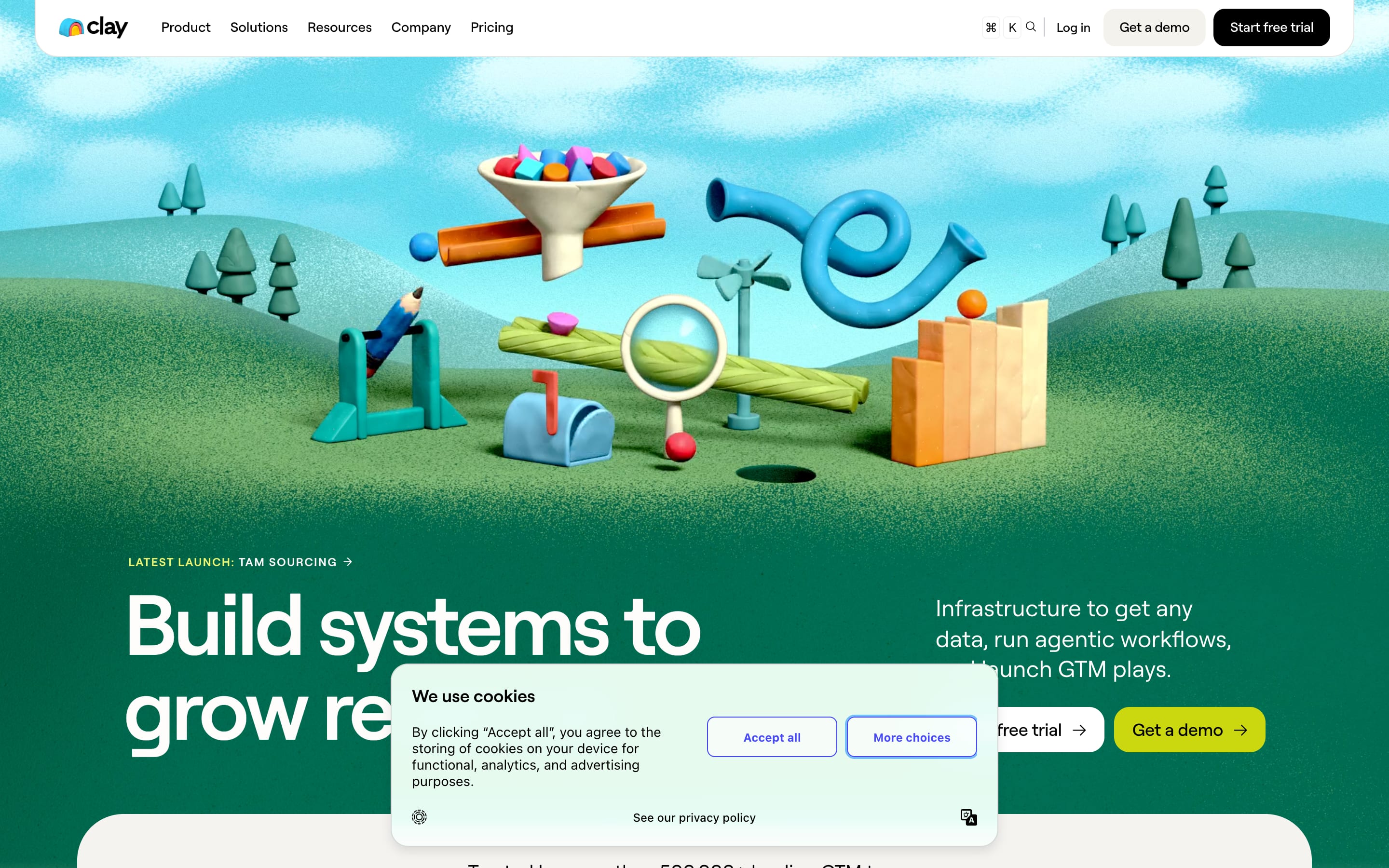
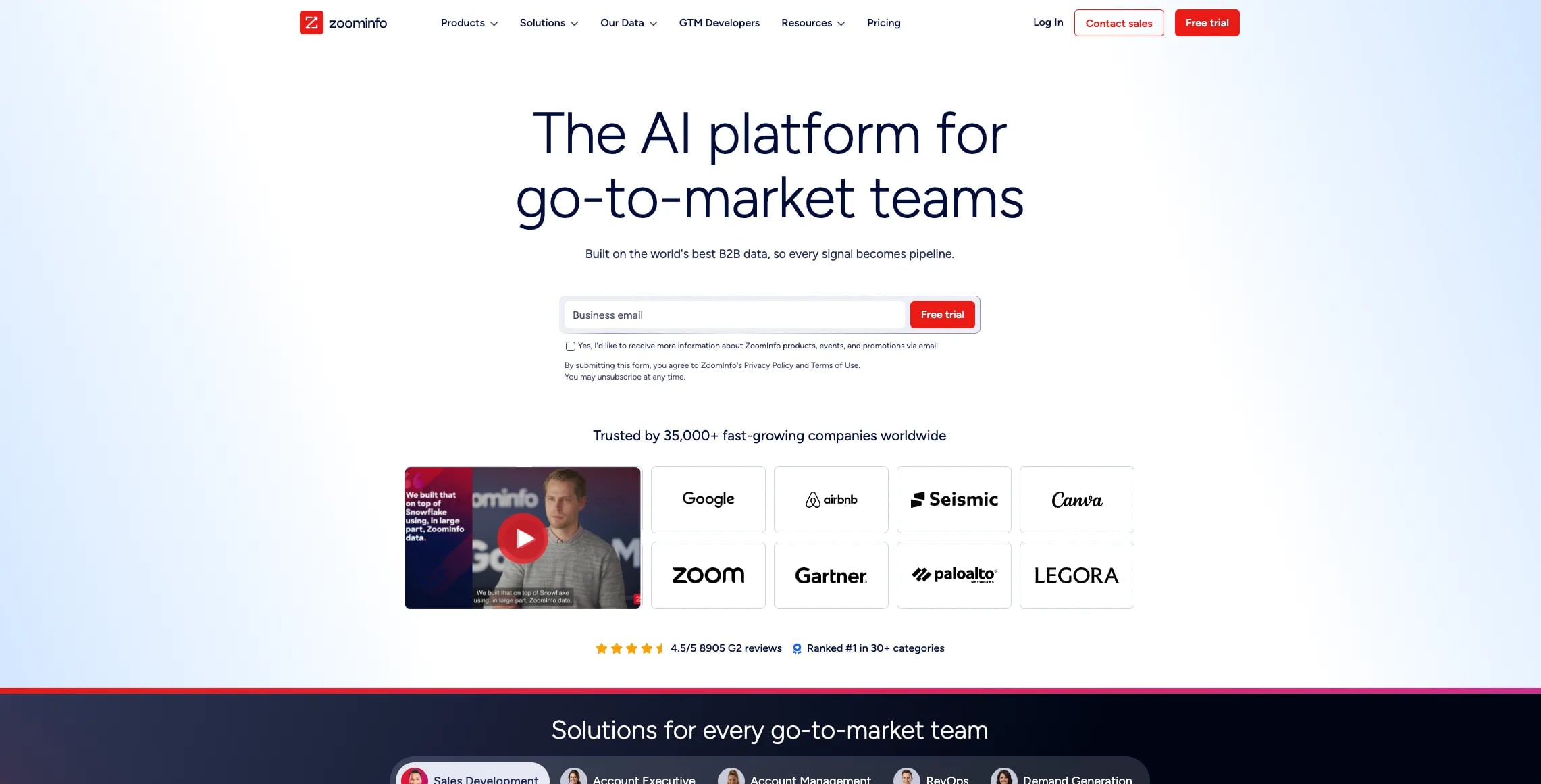
ZoomInfo is one contracted data source with intent and go to market workflow built around it, while Clay is the plumbing to buy from many sources at once, so the practical difference is whether you want a quote or a meter.
Pick Clay if
- You want to start today at a published price, or on the free tier, without procurement or a sales call.
- Coverage assembled from a marketplace of 200+ providers suits your market better than depending on one vendor's fill rate.
- Someone on the team will build and maintain the workflows, and Claygent's AI research is part of why you are buying.
- Unlimited seats and tables on every plan, including Free, fits your team better than per user licensing.
Pick ZoomInfo if
- Buying intent, website visitor identification, lead scoring and routing should come from one contracted vendor rather than be assembled provider by provider.
- Annual contracts and procurement are normal for you, and a quote sized on records under management is workable.
- Departments beyond sales need the same data, which ZoomInfo packages as Marketing, Operations and Talent editions.
- Enterprise scale is part of the decision: more than 35,000 customers and about $1.25 billion of 2025 revenue, per their annual report.
 Clay
Clay ZoomInfoClayZoomInfoClay
500 actions and 100 data credits per month, up to 200 rows per table, no phone number enrichment, no signals
500 actions and 100 data credits per month, Unlimited seats and tables, Multi provider waterfalls and Claygent included
Starts at 180,000 actions and 30,000 data credits per year, up to 50,000 rows per table, no CRM auto sync, no HTTP API integrations
180,000 actions and 30,000 data credits per year, Phone number enrichment and job change signals, Custom functions and scheduled enrichment runs
Starts at 480,000 actions and 72,000 data credits per year, CRM and warehouse imports capped at 250k, no SSO or RBAC without add on
480,000 actions and 72,000 data credits per year, CRM and data warehouse auto sync, Web intent signals, webhooks and unlimited ad audiences
Quoted per account, with 15 percent of annual credits eligible for rollover
Custom action and credit volumes, SSO, role based access control and workbook level credit budgets, 15 minute source sync and a dedicated growth strategist
From their published pricing, August 2026 (check their pricing page). Plans meter two things separately, actions and data credits, and the headline figure combines the minimum of each on annual billing. The same Launch plan on monthly billing works out higher, at about $60 per month for 15,000 actions plus about $125 per month for 2,500 data credits.
ZoomInfoA set amount of monthly credits, with additional credits available only by participating in their contributory network
Set amount of monthly credits, Extra credits for joining their contributory network, Access to contact data
Quoted per account on functionality, users and records under management
AI sales agent layer over their data, Account and buyer recommendations
Quoted per account on functionality, users and records under management
Company and contact search, Buying intent signals, Sales automation and engagement
Quoted per account on functionality, users and records under management
Account based marketing and audience activation, Website visitor identification, Ad targeting and form optimization
Quoted per account on functionality, users and records under management
CRM enrichment and data cleansing, Deduplication and lead routing, Data as a service delivery
Quoted per account on functionality, users and records under management
Candidate sourcing on the same data set, Recruiting workflows
ZoomInfo does not publish prices. Subscriptions are quoted per account based on the functionality, users and records under management included in each product edition, per their 2025 annual report, checked August 2026. Check their pricing page.
Clay pros
- Waterfall enrichment runs multiple providers in sequence, so coverage does not depend on any single vendor
- Claygent brings AI web research into the same table as the enrichment, on every plan including Free
- A genuinely usable free plan with 500 actions, 100 data credits, unlimited seats and unlimited tables
- Signals for job changes, promotions, hiring, company news and web intent turn static lists into triggers
- Deep technical surface: HTTP API integrations, webhooks, an API and CLI for coding agents, Clay MCP, and connectors in Claude and ChatGPT
Clay cons
- Two separate meters, actions and data credits, make total cost harder to predict than a flat per seat price
- Unused actions reset every month and do not roll over, per their published pricing
- Credit rollover is limited to roughly one month's worth on Launch and Growth, and top up credits cost a 30 percent premium
- CRM auto sync, HTTP API integrations and web intent signals are gated behind the $446 per month Growth tier
ZoomInfo pros
- One contracted source covering contact and company data, buying intent, website visitor identification, enrichment and routing
- Product editions map to whole departments: Sales, Marketing, Operations and Talent, rather than one generic seat
- Large integration marketplace spanning CRMs, dialers, data warehouses and AI assistants including Claude and ChatGPT
- AI layers shipped rather than promised, with Copilot, GTM Workspace, GTM Studio and an MCP server
- A free community edition, ZoomInfo Lite, with a monthly credit allowance
ZoomInfo cons
- No published pricing at all, so cost cannot be compared without a sales conversation
- Growth has flattened, with Q2 2026 revenue up 1.2 percent year over year and a $650.5 million goodwill impairment in the same quarter
- Net revenue retention was 90 percent at the end of 2025 and 87 percent a year earlier, meaning existing customers on average spent less than the year before
- Recent Trustpilot reviews are dominated by data removal and consent complaints rather than product criticism


Not in the way a data vendor does. Clay's model is a marketplace of 200+ providers combined with waterfall enrichment, which runs several sources in sequence until a record is found. Coverage therefore depends on which providers you enable and how many data credits you spend, rather than on one fixed database. ZoomInfo is the opposite model, a single contracted source under one agreement.
Clay publishes plans: Free with 500 actions and 100 data credits per month, Launch at $167 per month and Growth at $446 per month on annual billing, with Enterprise quoted, from their published pricing, August 2026. ZoomInfo publishes no prices, and per their 2025 annual report subscriptions are quoted per account on the functionality, users and records under management in each edition, checked August 2026.
Yes. Clay appears on ZoomInfo's integration marketplace, and Clay's model is designed to combine providers rather than replace all of them. Teams that already hold a ZoomInfo contract sometimes keep it as one source inside a Clay workflow, with other providers filling the gaps.
Both offer a free entry point, but they differ in effort. ZoomInfo Lite is a free community edition with a set amount of monthly credits and additional credits available for joining their contributory network. Clay's free plan is more generous in seats and tables, though Clay is a build environment rather than a point tool, which is why it runs a university, guides and a partner network to shorten the ramp.
Directory information is compiled from vendors' own published materials and other public sources, dated at verification time, and provided as is for research purposes. All product names, logos and screenshots are the property of their respective owners and are used for identification only; Weezly is not affiliated with or endorsed by the listed vendors unless stated. Verify current terms with the vendor before purchasing. About the data