Early access: free while we build it. Weezly Signals is live in Weezly today. It runs around the clock and uses none of your credits. Once it leaves early access it becomes a paid add-on, and we will tell you well before that happens.
Someone just posted on LinkedIn that they are fed up with lemlist. Someone else asked their network which LinkedIn automation tool to switch to. A third person commented under that post: "Following, we have the same problem."
All three are telling you, in public, that they might buy. Most sales teams never see those posts. The few that do usually see them in a separate signals tool, export a CSV, clean it, paste it into an outreach tool and write the first message by hand, a week later, when the moment has passed.
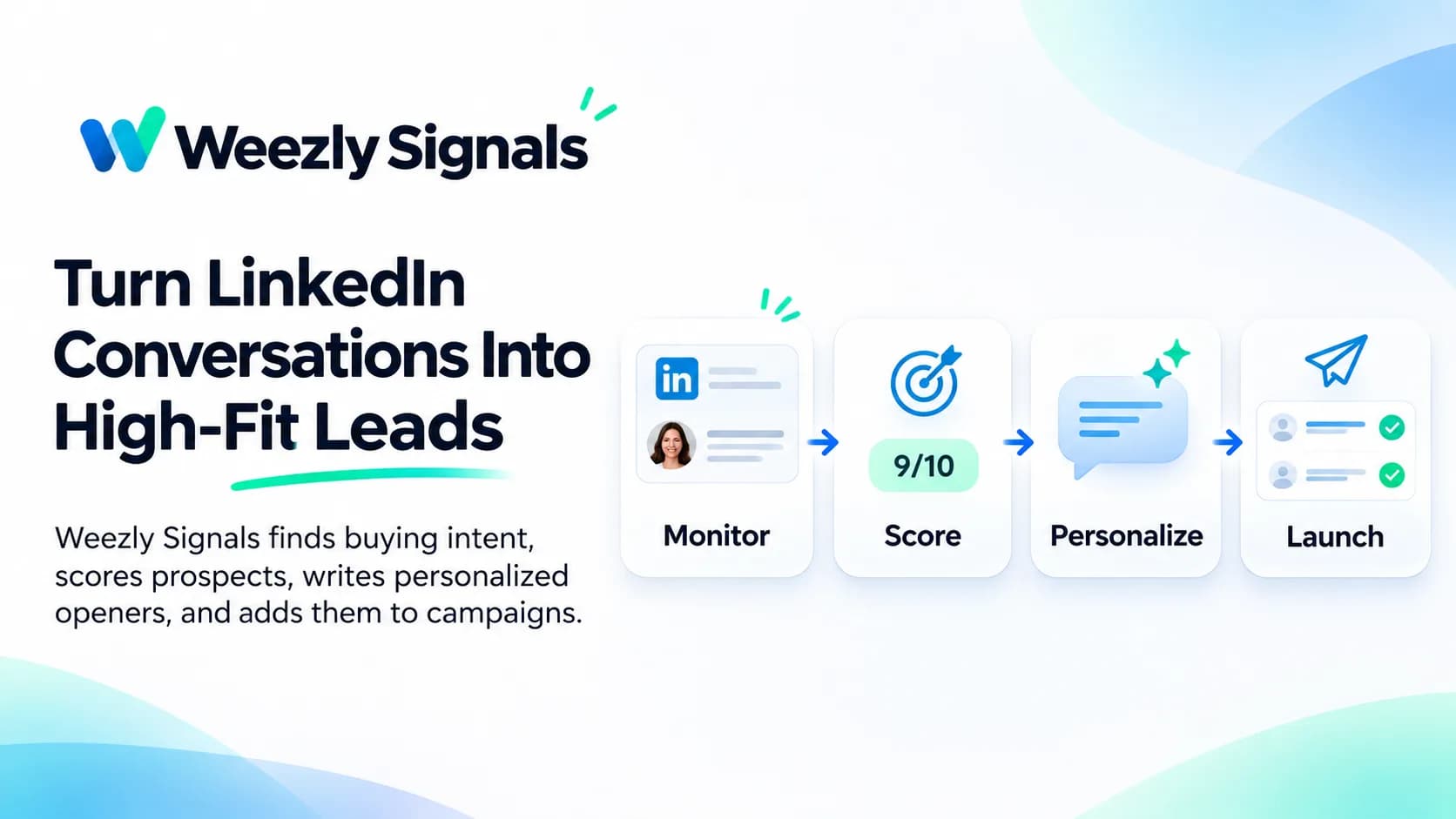
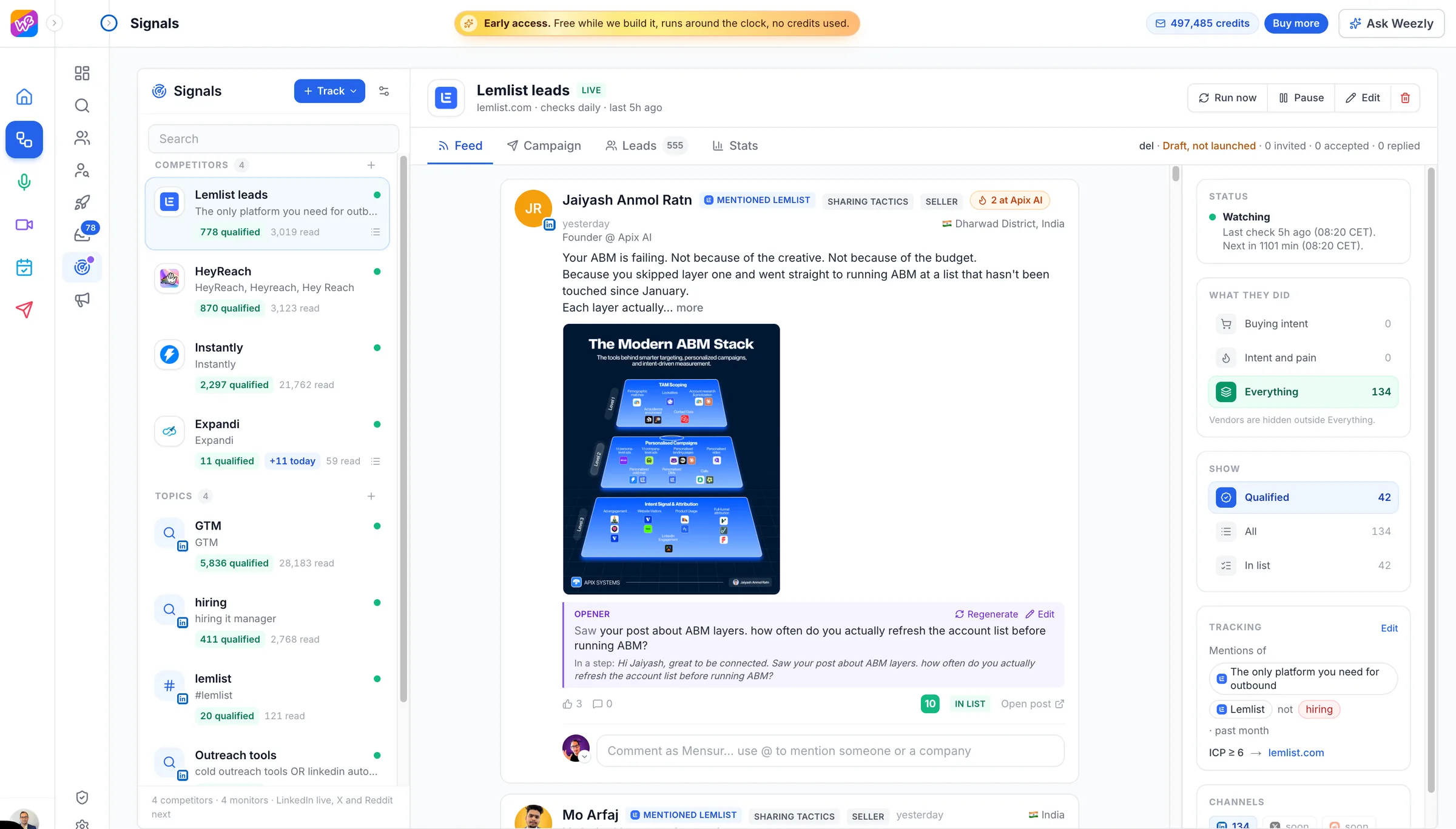
Today we are launching Weezly Signals. It finds those people, tells you which of them fit your ideal customer, writes an opener from what they actually wrote, and puts them into a LinkedIn campaign. All in one place, every day, without the export.
What Weezly Signals is, in one paragraph
Weezly Signals is a LinkedIn intent tool built into Weezly. You tell it what to watch: a competitor, a topic, a hashtag, a company name, the people engaging with a specific post or with your own posts, or companies hiring for a role. It reads every matching post, sorts buyers from vendors, scores each person 1 to 10 against your ideal customer profile, writes a personal opener based on their post, and either adds them to a lead list or sends them straight into a campaign that runs by itself. X and Reddit are next.
Here is the full walkthrough from Mensur, our founder:
Why signals beat cold lists
A cold list tells you who someone is. A signal tells you what they are thinking about this week. The difference shows up in the reply rate, because a message about something a person just said does not read like a cold message at all.
But a signal on its own is only half the job. A person can post about your competitor and still be the wrong buyer: a freelancer, a student, a recruiter, or another vendor selling against the same tool. That is why Weezly Signals scores every person before anyone gets a message. In Weezly campaign data, leads scoring 6 and above on our 1 to 10 ICP score replied 2.97x more often than leads below 6 (Weezly campaign data, 2026; how we measured it).
What you can track
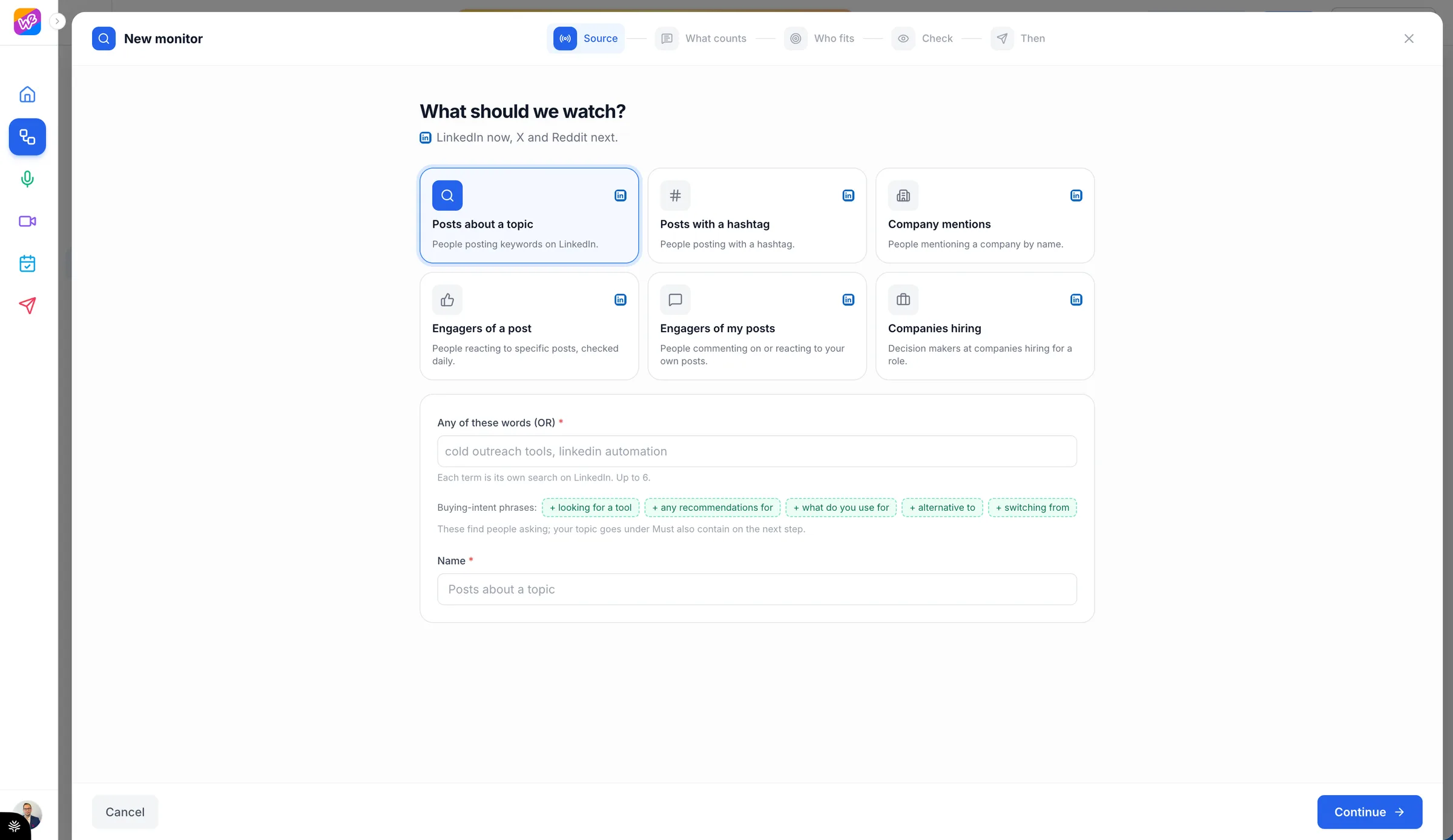
A new monitor starts with one question: what should we watch? There are six sources on LinkedIn today.
- Posts about a topic. People posting your keywords. Up to six search terms per monitor, each its own search.
- Posts with a hashtag. Everyone posting with #yourhashtag.
- Company mentions. People mentioning a company by name, which is how you track a competitor.
- Engagers of a post. Everyone reacting to a specific post, checked daily. Perfect for a competitor's launch post or an influencer's viral thread.
- Engagers of your own posts. The people commenting on or reacting to what you publish.
- Companies hiring. Decision makers at companies hiring for a role.
One click adds buying-intent phrases to a topic: "looking for a tool", "any recommendations for", "what do you use for", "alternative to", "switching from". Those find the people who are asking, not just the people who are talking.
Track a competitor, and keep only the posts that matter
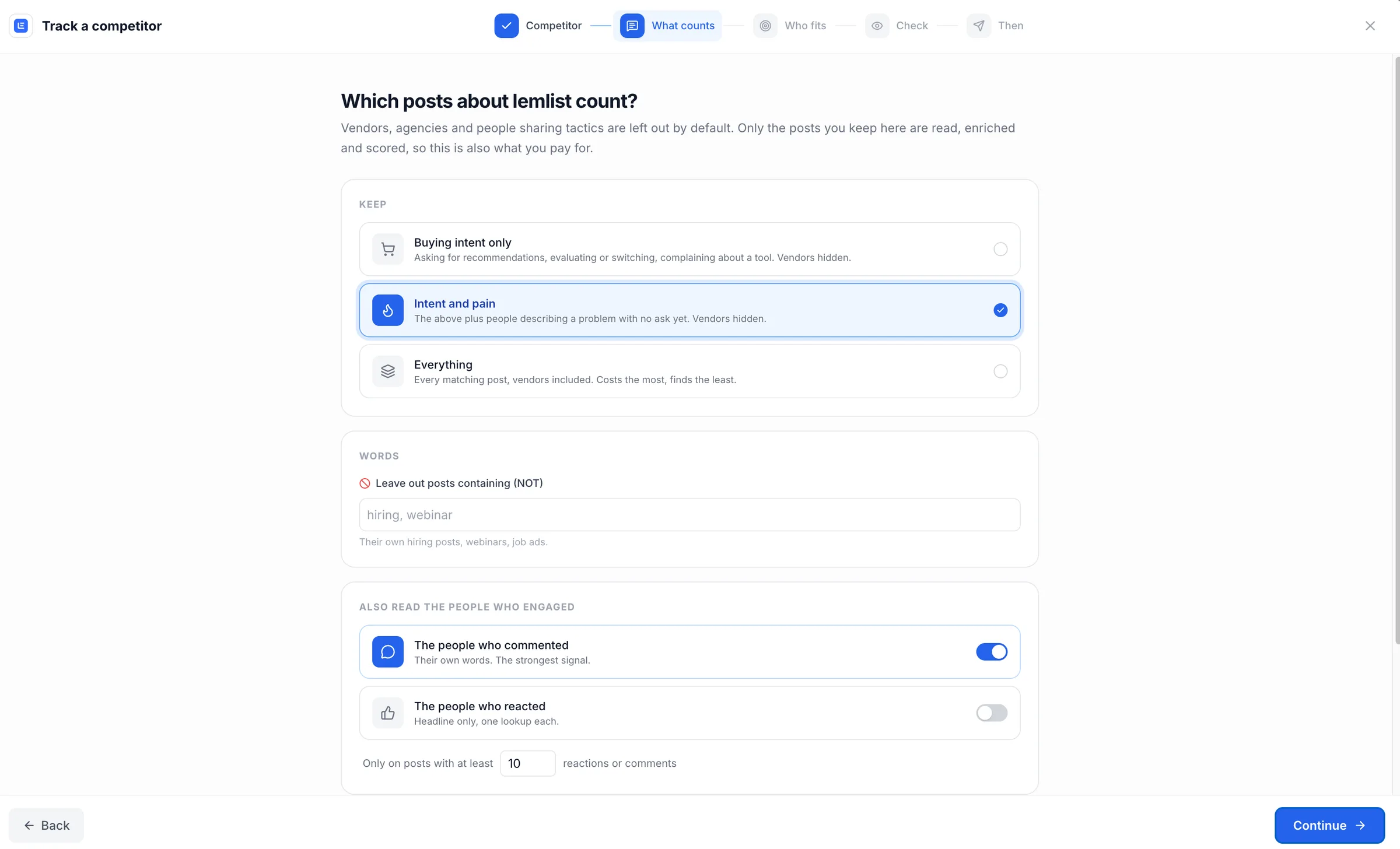
Tracking a competitor is a five-step setup: the competitor, what counts, who fits, a check, then what happens next.
"What counts" is where most signal tools stop being useful, because most posts that mention a tool are written by people selling something. Weezly reads every post and lets you choose what to keep:
- Buying intent only. Asking for recommendations, evaluating or switching, complaining about a tool. Vendors hidden.
- Intent and pain. All of the above, plus people describing a problem without asking for a tool yet. Vendors hidden.
- Everything. Every matching post, vendors included.
You can leave out posts containing words like "hiring" or "webinar", so a competitor's own job ads never land in your feed. And you can choose to read the people who engaged too: the people who commented (their own words, the strongest signal) and the people who reacted, on posts with at least as many reactions or comments as you set. You also pick how far back to look, and narrow the people by country, city and company size.
Every person gets an ICP score, and the good ones go straight to your list
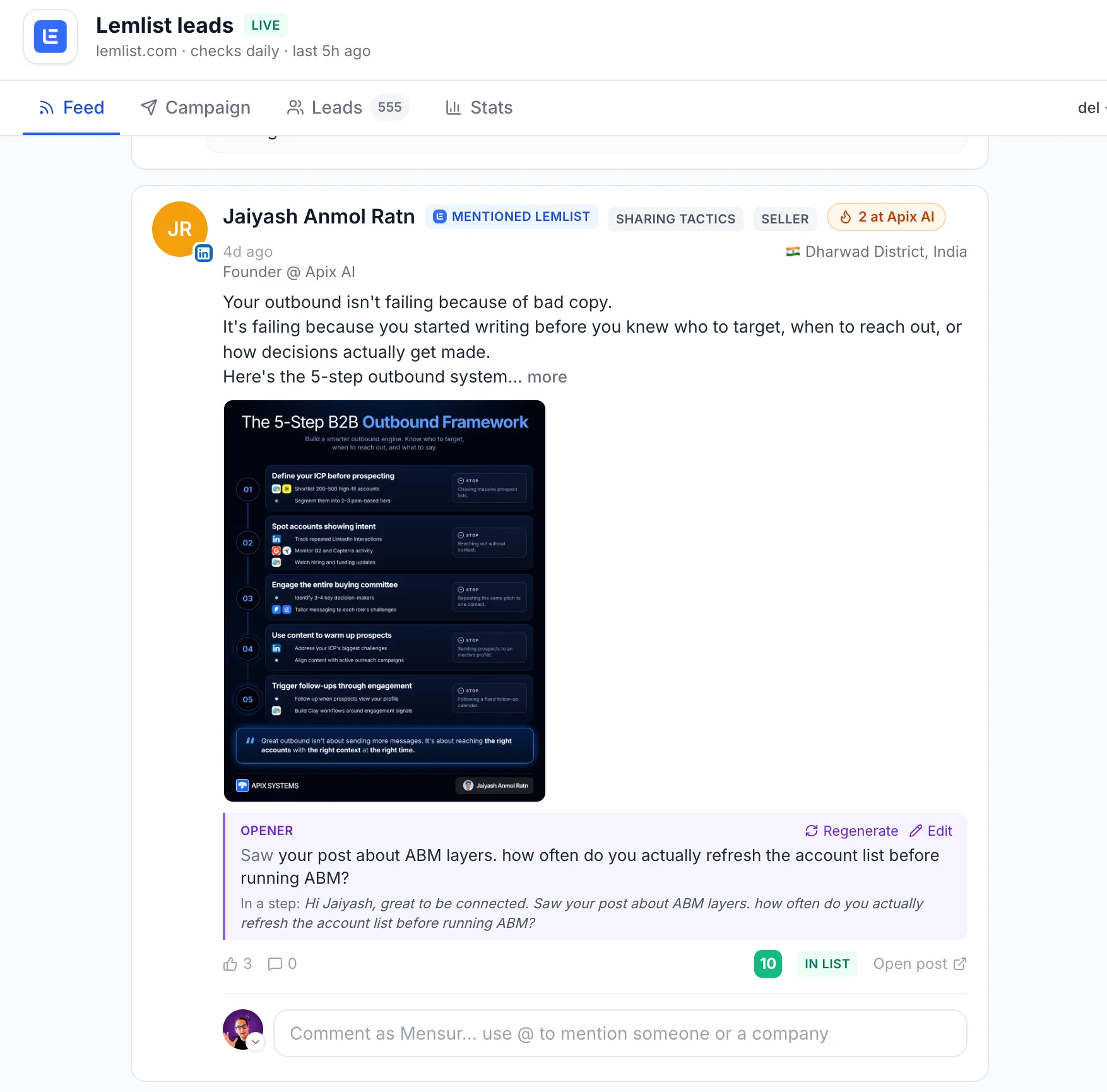
Each post in the feed is tagged so you see at a glance what it is: who it mentioned, whether the author is sharing tactics, whether they are a seller. Next to it sits the author's ICP score from 1 to 10. Set the bar (we recommend 6) and everyone at or above it is added to your lead list automatically, with no manual triage.
The people in the comments are leads too
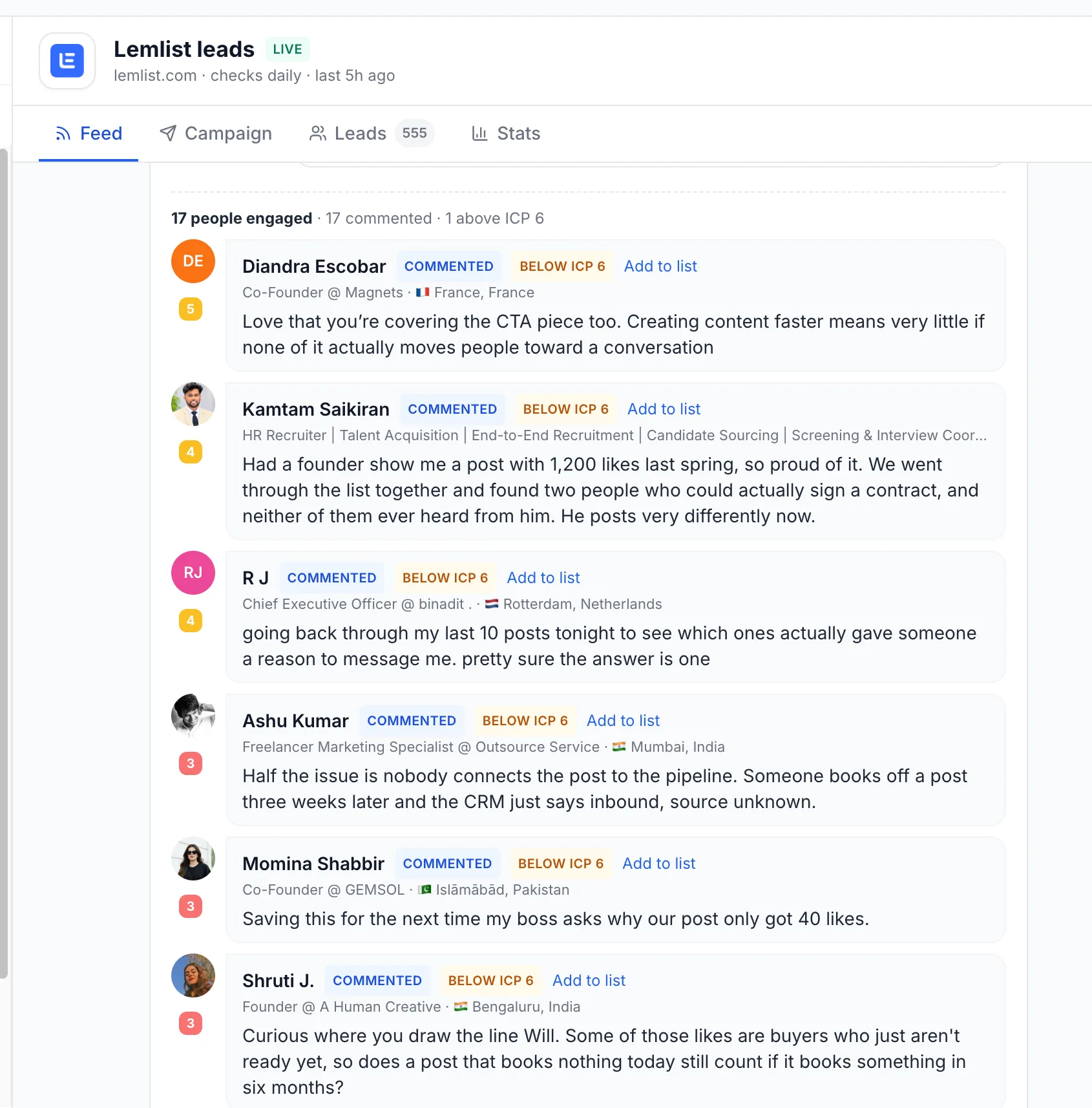
The author is one person. The comment section is often twenty. Weezly Signals reads the people who commented on a post and scores each of them the same way, showing their comment, their role and their score. Anyone above your bar can be added to the list in one click, or automatically.
Reactions work the same way. Someone who liked a post about switching away from your competitor has raised a hand, quietly. Now you can see whether they fit.
An opener written from their own post
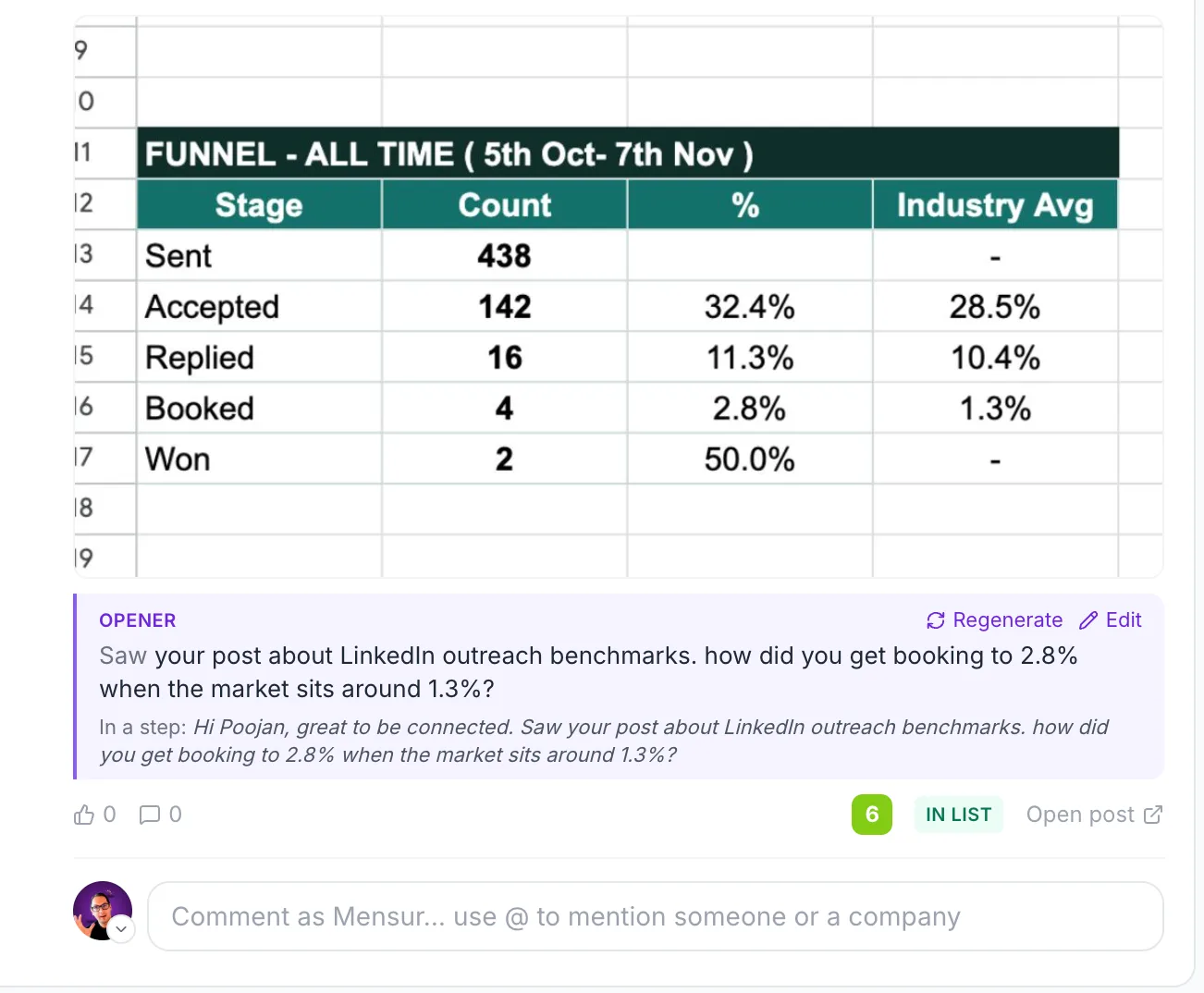
"Hi, I saw you are in sales" is not personalisation. Weezly Signals reads the post and writes the first line about what the person actually said. For a post comparing LinkedIn outreach results with industry benchmarks, the opener reads: "Saw your post about LinkedIn outreach benchmarks. How did you get booking to 2.8% when the market sits around 1.3%?"
The opener drops into your sequence as a variable, so the message reads naturally after the connection is accepted: "Hi Poojan, great to be connected. Saw your post about..." You can regenerate it or edit it before anything is sent. It does not read like AI wrote it, because it is about them, not about you.
The campaign builds itself, and new leads jump the queue
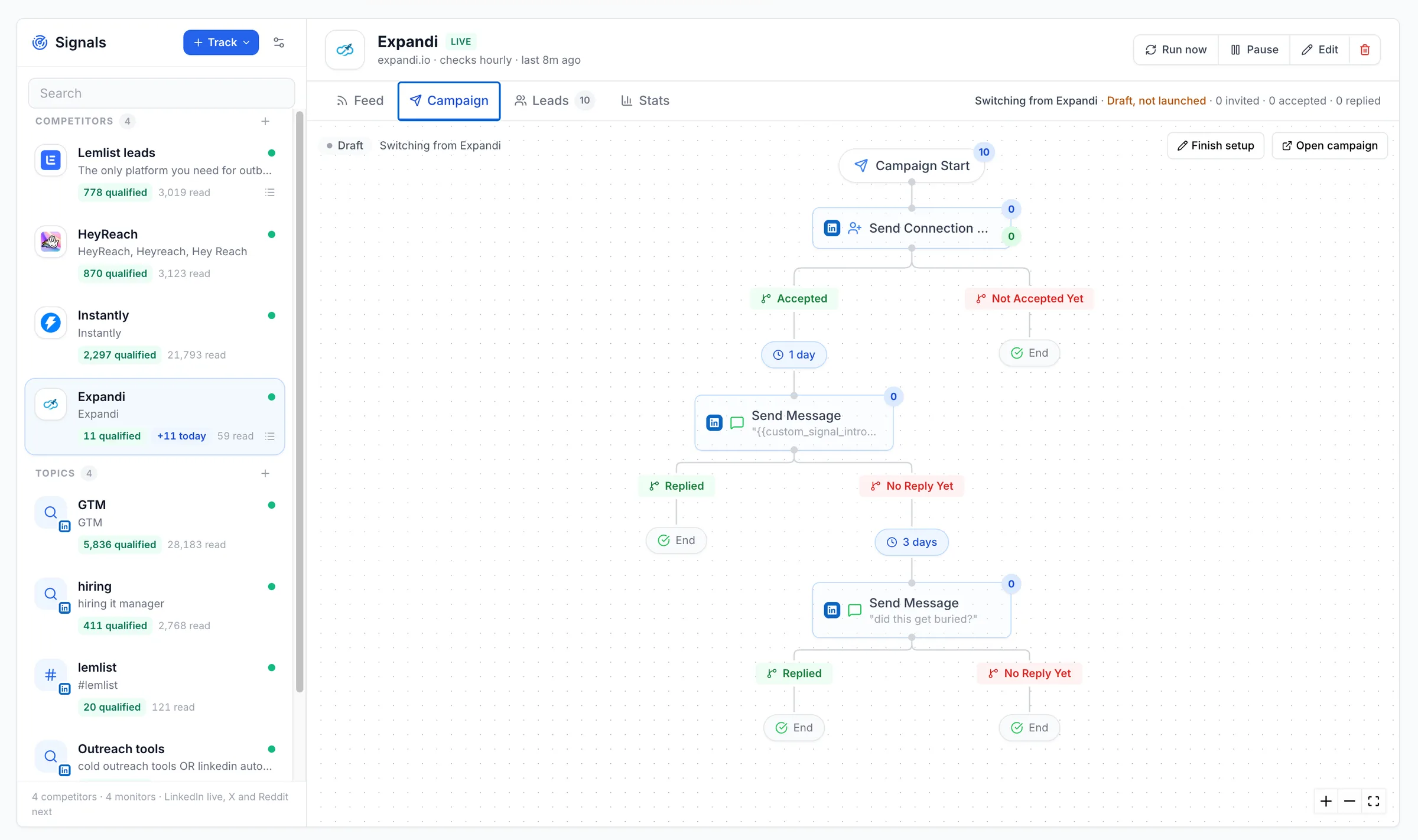
At the last step you choose what happens next. Either every new lead goes to a lead list and you build the campaign yourself, or Weezly creates the campaign for you: a connection request, the custom opener one day after they accept, and a short nudge three days later if they have not replied.
From then on it runs by itself. Each time the monitor checks LinkedIn (daily or hourly), new matching people are scored, the ones above your bar get their opener and join the campaign, ahead of older leads in the queue, so they hear from you while their post is still fresh. You never export anything.
Hot accounts: when one company keeps showing up
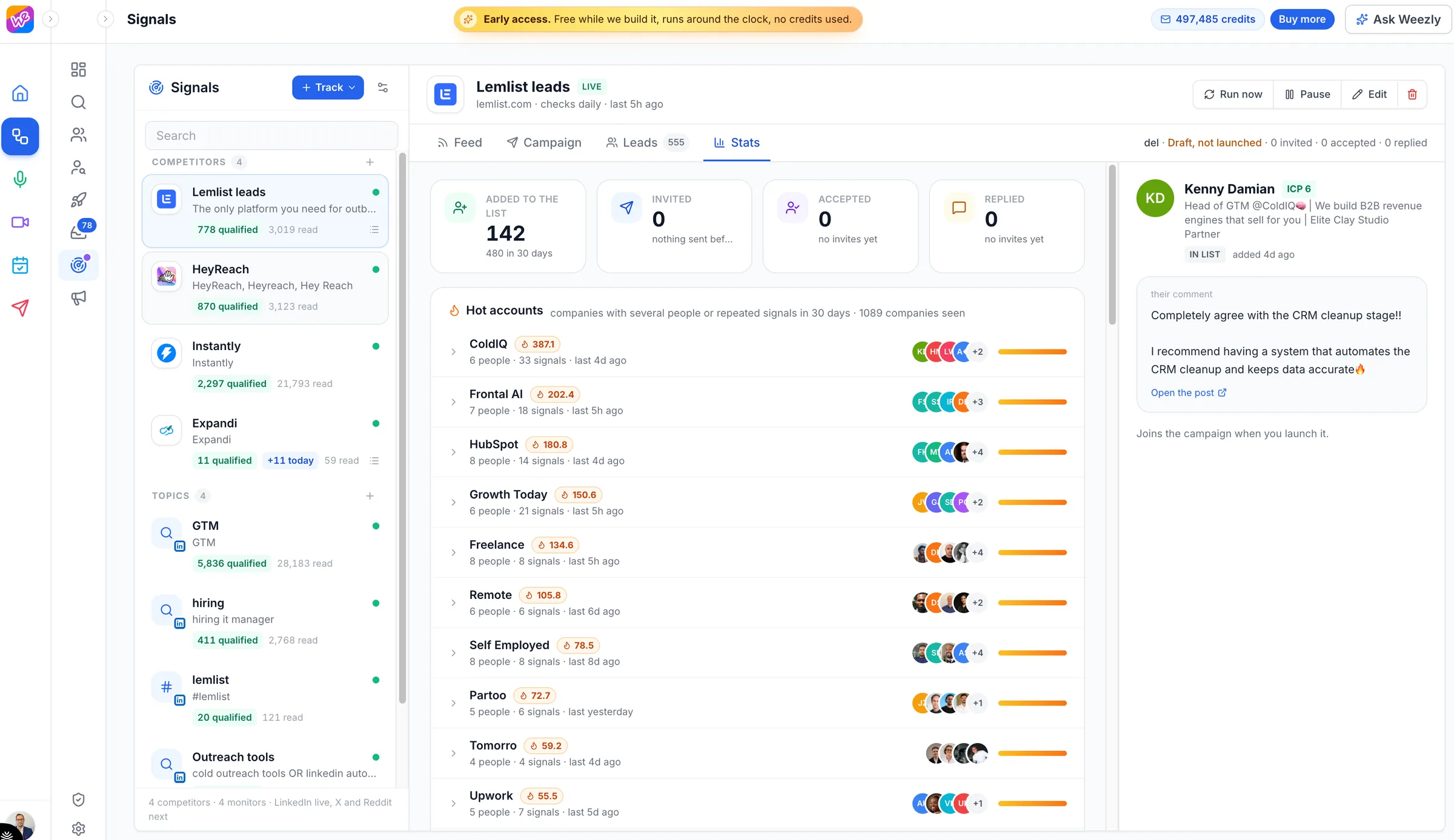
One person posting about your competitor is a signal. Six people from the same company doing it in a month is a buying committee. Weezly Signals groups the people it finds by company and ranks the companies with several people or repeated signals in the last 30 days, with a heat score, the number of people and signals, and when the last one came in. Open a company to see every person and what they said, then reach them all.
Comment on the post without opening LinkedIn
Sometimes the right first move is not a DM. Under every post in the feed there is a comment box: pick which of your LinkedIn profiles to comment as, @mention a person or a company, and post. You join the conversation where it is happening, and your name is familiar before the connection request arrives.
How Weezly Signals compares to other signal tools
There are good signal tools on the market, and some of them track sources we do not. Here is what each vendor says on its own website, checked in November 2026. "Not advertised" means we could not find it on their site, not that it cannot be done.
| Checked Nov 2026 | Weezly Signals | Valley | Common Room | Teamfluence | Gojiberry | Octolens | Clay |
|---|---|---|---|---|---|---|---|
| LinkedIn posts by keyword or competitor | Yes | Engagers of those posts | Not advertised | Yes | Competitor engagement | Yes | Engagers of those posts |
| People who commented or reacted | Yes, scored | Yes | Not advertised | Yes | Yes | No | Yes |
| Separates buyers from vendors | Yes | Not advertised | Not advertised | Not advertised | Not advertised | Buy-intent tag | Not advertised |
| ICP score per person | 1 to 10 | Fit label | AI scoring | Yes | Yes | Not advertised | Build your own |
| Opener written from the post | Yes | Drafts a first message | AI messages | Not advertised | AI messages | Not advertised | Build your own |
| Sends the LinkedIn campaign itself | Yes | Yes | Pushes to other tools | Connection requests | Yes | No | Pushes to other tools |
| Comment on the post from the tool | Yes | Not advertised | Not advertised | Not advertised | Not advertised | Not advertised | Not advertised |
| Company rollup | Hot accounts | Not advertised | Buying committee | Target account list | Not advertised | Not advertised | Not advertised |
| Other sources | Hiring; X and Reddit next | Job changes, funding, profile views | Website visits, 50+ sources | Profile and page visits, ads | Website visitors | 10+ networks | Job changes, news, web intent |
| Price | Free in early access | From $199 a month per seat | From $2,500 a month, billed yearly | €449 a month | $99 a month | From $159 a month, billed yearly | Free plan without signals; paid plans for signals |
Each vendor's published pricing and product pages, November 2026.
Where others are ahead today: Common Room and Gojiberry identify website visitors, which we do not. Valley tracks job changes, funding and profile viewers, and sends email as well. Octolens covers more than ten networks, including Reddit and X, right now. Clay is the most flexible if you like building your own workflows. If one of those sources is the one you need, they are good choices.
Where Weezly Signals is different is the distance from signal to conversation. The post, the score, the opener, the campaign and the comment all happen in one tool, and the outreach runs from the same Weezly account that already sends your LinkedIn and email sequences. Nothing to connect, nothing to export.
Looking for a Trigify alternative?
Trigify announced on its website that its team is joining HubSpot and that the standalone Trigify platform is being retired. If you used it to track LinkedIn engagement and keyword posts, Weezly Signals covers the same ground (topics, competitors, engagers of posts) and then goes one step further: it scores the people, writes the opener and runs the outreach. While Signals is in early access, moving over costs you nothing.
How to start
- Open Signals in Weezly and click Track.
- Pick what to watch: start with your biggest competitor and "Intent and pain".
- Set who fits: the ICP bar at 6, plus any country or company size you want.
- Choose what happens next: a lead list, or a campaign that builds and runs itself.
New to Weezly? Start with a free trial: 21 days on the Multichannel seat, 7 days on the Growth plan. Set up takes about five minutes.
Frequently asked questions
What is a LinkedIn intent signal?
A public action on LinkedIn that suggests someone may be in the market: a post asking for a tool recommendation, a complaint about a competitor, a comment saying "we have the same problem", or a reaction to a post about switching tools. Weezly Signals finds these and tells you which of the people behind them fit your ideal customer.
Is Weezly Signals free?
Yes, while it is in early access. It is free while we build it and uses none of your credits. When it leaves early access it becomes a paid add-on, and we will announce the price before anything changes.
Which networks does it cover?
LinkedIn today. X and Reddit are next.
How does the ICP score work?
Weezly reads your website once and builds your ideal customer profile: who buys, the titles and headline words that signal fit, and who you never want to contact. Every person found by Signals is scored 1 to 10 against it. You can edit the profile any time. Here is what we learned scoring 2,681 contacted leads.
Do I have to message people automatically?
No. You can send new leads to a list and build the campaign yourself, edit or regenerate every opener, or just comment on the posts. Automatic campaigns are an option, not the default.
How often does it check?
Each monitor checks LinkedIn on a schedule, daily or hourly, and you can run it on demand at any time.
Early access
Weezly Signals is free while we build it.
Use every feature at no cost during early access: all six LinkedIn sources, ICP scoring, AI openers, hot accounts and campaigns that run by themselves. It runs around the clock and uses none of your credits. When Signals leaves early access it becomes a paid add-on, and we will tell you well in advance. Until then, everything you set up is yours to use for free.