August 10, 2026 · 4 min read
The Review-Site Split: Why the Same Sales Tool Scores 4.8 on G2 and 2.9 Everywhere Else
For 40 of 93 sales tools the review picture splits by whole stars across platforms, including our own product. Why it happens and how to read reviews anyway.
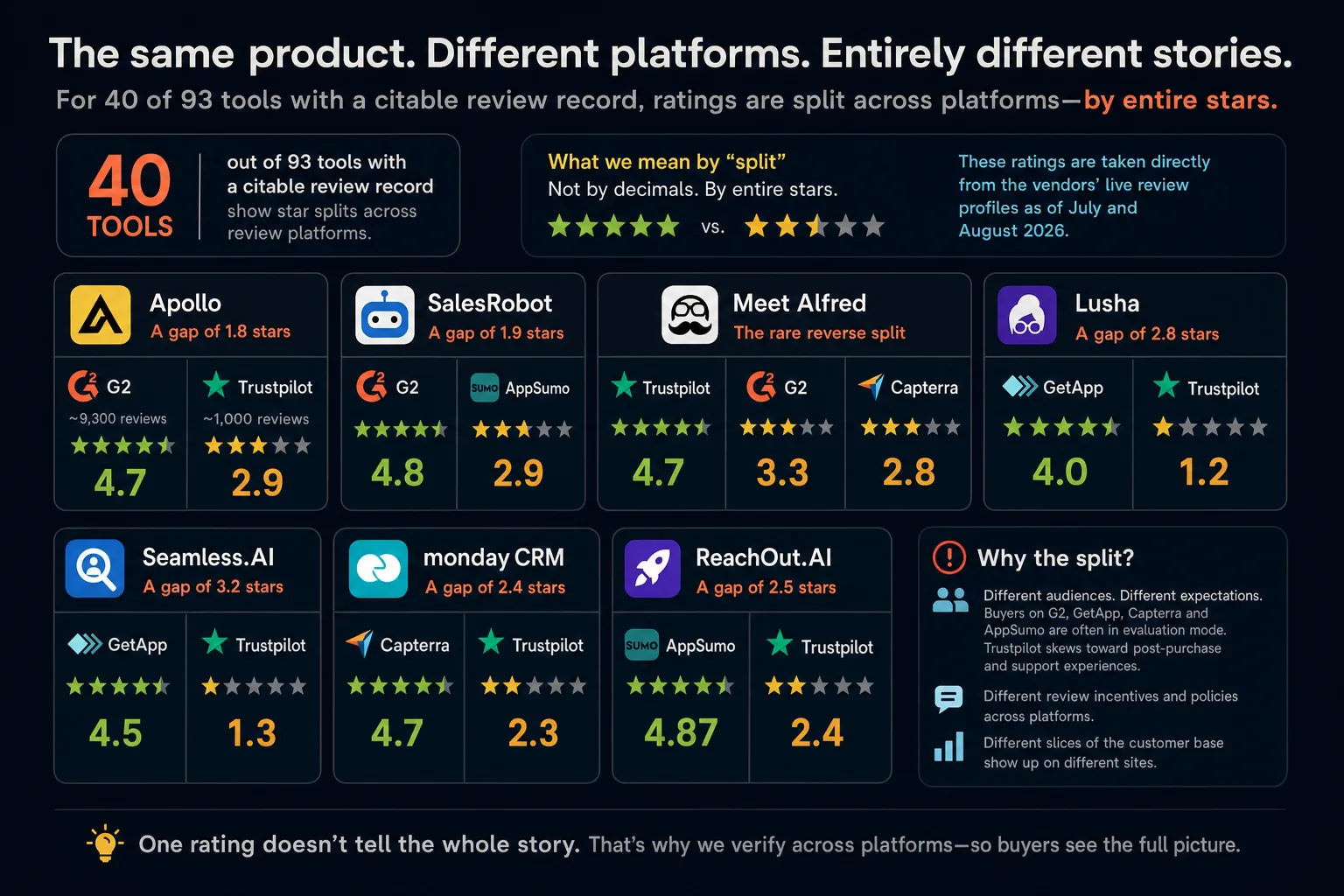
Here is a puzzle from our research for the GTM tools directory, where we verify the public record of 106 sales tools by hand: for 40 of the 93 tools with a citable review record, the picture is split across review platforms. Not by decimals. By entire stars.
Some examples, all from the vendors' live review profiles as of July and August 2026:
Apollo: 4.7 on G2 across roughly 9,300 reviews, 2.9 on Trustpilot across roughly 1,000. A gap of 1.8 stars on the same product.
SalesRobot: 4.8 on G2, 2.9 on AppSumo.
Meet Alfred: 4.7 on Trustpilot, 3.3 on G2, 2.8 on Capterra. The rare reverse split, loved on Trustpilot and criticized on the software sites.
Lusha: around 4.0 on GetApp, 1.2 on Trustpilot.
Seamless.AI: 4.5 on GetApp, 1.3 on Trustpilot.
monday CRM: 4.7 on Capterra, 2.3 on Trustpilot.
ReachOut.AI: 4.87 on AppSumo, 2.4 on Trustpilot.
And in the interest of the fairness we keep preaching: Weezly, our own product, shows the split too. 5.0 on G2, 4.0 on Trustpilot. Smaller review counts, same phenomenon. Nobody is exempt, including the people writing this article.
The split is not noise. It is two different questions being answered.
Once you see enough of these, the pattern stops looking like measurement error and starts looking structural. Each platform recruits a different reviewer at a different moment, and effectively asks a different question.
G2, Capterra and GetApp ask: does the product work for you? Their reviewers are mostly active users, often invited by the vendor during a good moment, sometimes with an incentive. The population skews toward people for whom the tool is working. That does not make the reviews fake; it makes them a survey of successful, current users. G2's own review flow encourages structured, feature-level feedback, which is genuinely useful for evaluating capability.
Trustpilot and AppSumo ask: how did this company treat you? Trustpilot requires no proof of sustained product use, so its natural audience is whoever feels strongly enough to find the page, and the strongest feeling in SaaS is being charged when you expected not to be. Read the one-star reviews behind the splits above and the themes repeat with remarkable consistency: renewals that were hard to cancel, credits that expired, refunds that did not come, support that went quiet after the sale. AppSumo's population is different again: lifetime-deal buyers who paid once, expect forever, and review the gap between that expectation and reality.
So a 4.7 on G2 and a 2.9 on Trustpilot are not contradicting each other. The first says the product works when you use it. The second says exiting, downgrading or disputing a charge can be painful. Both facts can be true, and for a buyer, both matter.
How to actually read reviews, given the split
Never read one platform. A single score is half a story by construction. Our rule in the directory: show both sides or show none.
Read the platforms in pairs. G2 high plus Trustpilot high: rare and genuinely reassuring. G2 high plus Trustpilot low: the product likely works, so read the Trustpilot themes and go straight to the billing terms before you buy. G2 low plus Trustpilot high, the Meet Alfred pattern: the company may be pleasant to deal with while the product underdelivers for power users.
Weight themes, not scores. Twenty one-star reviews that all say "credits expired" tell you one precise, verifiable fact. Check it against the vendor's own terms. We did exactly that across the directory, and the complaint themes almost always matched something real in the fine print.
Check the denominators. A 4.9 from 10 reviews and a 4.4 from 3,000 are not the same claim. Several tools in our data pair a glowing score on one platform with a sample too small to mean anything.
Distrust any directory showing you a single star rating, including an aggregated one. Averaging a capability survey with a billing-grievance log produces a number that measures nothing. It is why our directory shows sourced, two-sided review records and no stars at all.
What vendors should take from this
The split is mostly earned on the worst day of the customer relationship, not the best. The fixes are unglamorous: cancellation that works in-product, credits that do not expire silently, refund terms a human can read. The vendors in our data with the smallest splits are rarely the ones with the best products. They are the ones with the fewest billing surprises.
Every tool mentioned here has a full dossier with its review record, pricing mechanics and the dates we checked, in the GTM tools directory. Related reading: we verified the pricing of 106 sales tools by hand.
Weezly builds LinkedIn outreach software with AI video. As noted above, our own review record shows the same split we describe, and we would rather tell you that than have you find it yourself.