August 10, 2026 · 4 min read
The Credit Trap: How 28 Sales Tools Meter What You Actually Buy
More than a quarter of sales tools bill through credits, and credits are where pricing gets creative. Five traps we found, verified against vendors own pages.
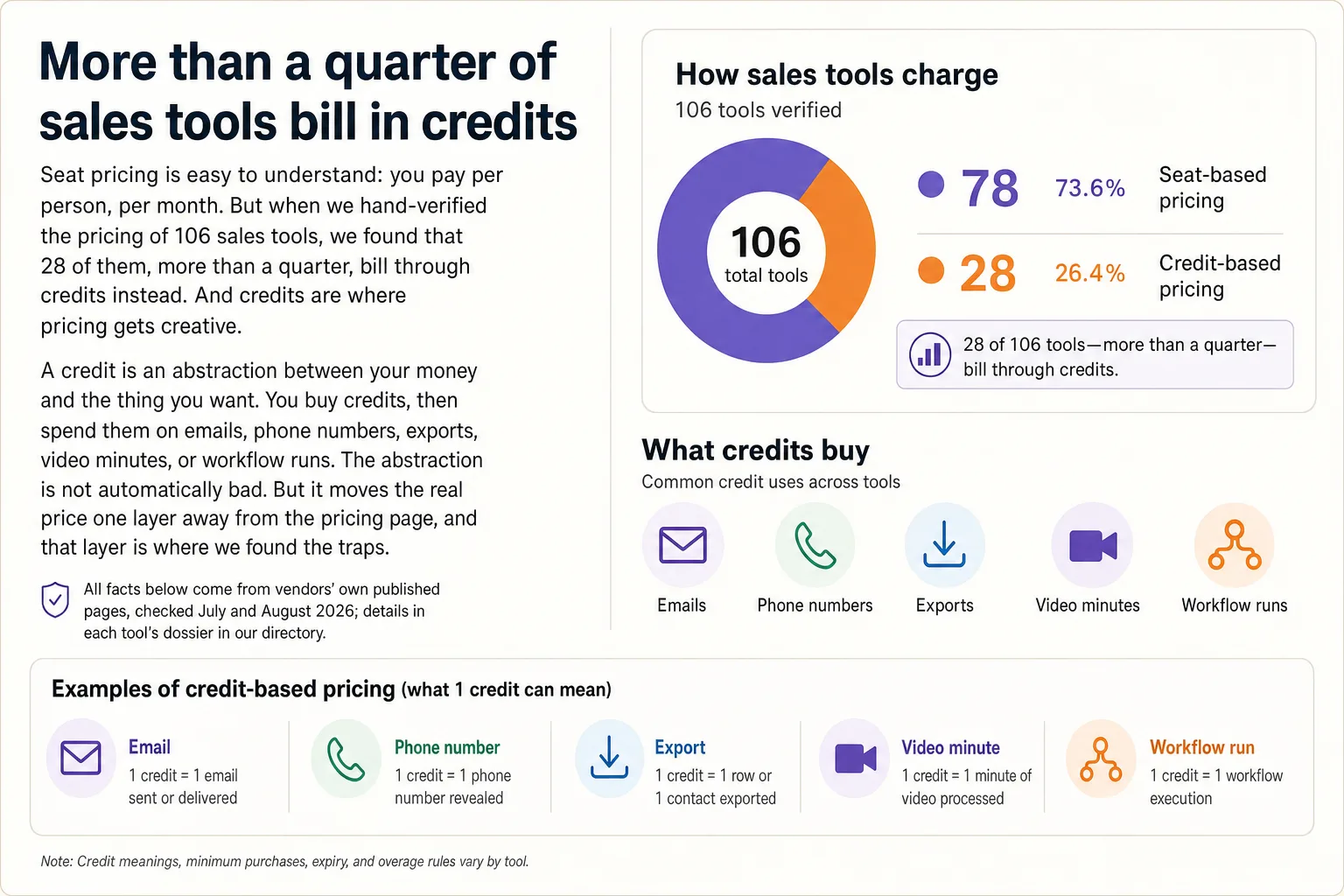
Seat pricing is easy to understand: you pay per person, per month. But when we hand-verified the pricing of 106 sales tools, we found that 28 of them, more than a quarter, bill through credits instead. And credits are where pricing gets creative.
A credit is an abstraction between your money and the thing you want. You buy credits, then spend them on emails, phone numbers, exports, video minutes, or workflow runs. The abstraction is not automatically bad. But it moves the real price one layer away from the pricing page, and that layer is where we found the traps. All facts below come from vendors' own published pages, checked July and August 2026; details in each tool's dossier in our directory.
Trap 1: Credits that expire
The clearest example is a direct head-to-head. NeverBounce, the email verifier owned by ZoomInfo, sells credits that expire 12 months after purchase. Its direct competitor ZeroBounce sells credits that never expire, and says so prominently, because it knows exactly whose customers it is courting. Browse NeverBounce's Trustpilot page and expiring credits are the dominant complaint theme.
Before buying any credit pack, find the expiry answer in writing. "Do credits roll over?" is the single highest-value question in a sales-tool demo.
Trap 2: The same credit buys different things
On Apollo, revealing an email address costs 1 credit. Revealing a mobile number costs 8. Exporting a record costs another credit on top. A list that looks cheap as "email finding" becomes eight times more expensive the moment your SDRs want to call people.
LeadIQ prices the same way with different math: 1 credit for an email, 10 for a phone number, 11 for both, 3 to enrich an account. Evaboot charges 2 credits when a lead comes back with a verified email and fewer when it does not. None of this is hidden, exactly. It is in the docs. But the headline price never mentions it, and the difference between an email-only workflow and a calling workflow can be the difference between a $49 month and a $400 month on the same plan.
Trap 3: "Unlimited," capped
RocketReach sells its annual plans as unlimited lookups. The fine print caps exports at 1,200, 3,600 or 20,000 contacts per year depending on tier. Unlimited looking, limited taking. Similar asterisks appear across the category: unlimited seats with metered actions, unlimited contacts with metered sends.
Whenever a credit-model vendor says unlimited, ask: unlimited what, and what is the number on the thing next to it?
Trap 4: Two meters on one bill
Clay, the GTM engineering darling, runs two meters at once: actions and data credits, and its plans combine both. Unused credits roll over for about a month, and topping up mid-cycle carries roughly a 30 percent premium over bundled credits. Relevance AI similarly meters actions and vendor credits separately. Two meters means two ways to run out, and mid-cycle top-ups are where the effective price quietly climbs.
Trap 5: The overage schedule
Overage is the price of success. Apollo charges $0.20 per extra credit with a 250-credit minimum. Wiza charges $0.15 per extra email and $0.35 per phone number on monthly plans. RocketReach's overage runs $0.32 to $0.45 per lookup depending on plan. These rates are usually fair, but they are also usually absent from the comparison spreadsheet you built when choosing the tool. If your volume is growing, the overage schedule IS your price.
The fair side of credits
Credits are not a scam, and some vendors handle them honorably. RocketReach refunds lookups that return nothing verified. ZeroBounce publishes a written refund formula alongside its accuracy claim. Hunter meters generously with unlimited seats on every plan. The model itself is neutral; what varies is how much of the mechanics a vendor puts on the pricing page versus in the support docs.
The four questions that defuse all five traps
What exactly does one credit buy, for each data type I need?
Do unused credits expire or roll over, and after how long?
What is the overage rate once I exceed the plan?
Is anything labeled unlimited, and what sits next to it that is not?
Every credit-metered tool in our directory has these mechanics documented in its dossier with the date we checked, from Apollo to ZeroBounce. No affiliate links, and when a vendor's docs left a question open, the dossier says that instead of guessing.
Weezly builds LinkedIn outreach software with AI video. Our own pricing is per sender with video minutes in packs, and yes, the mechanics are documented in our own dossier with the same scrutiny.