

Make
GTM EngVisual automation platform for building workflows and AI agents across 3,000+ apps
The most flexible visual automation platform in the GTM stack, priced by consumption rather than seats, which rewards teams willing to learn it and punishes unoptimized scenarios.
Best for
GTM engineers and ops teams who want to wire a revenue stack together visually, at a price that scales with usage rather than headcount.
Not great for
A team that wants two apps connected in five minutes and never touched again, where a simpler trigger-action tool costs less thinking.
Starting price
$9/mo
Pricing model
Credit packs
Free trial
Free plan instead
Platforms
Web app
Make, in plain terms
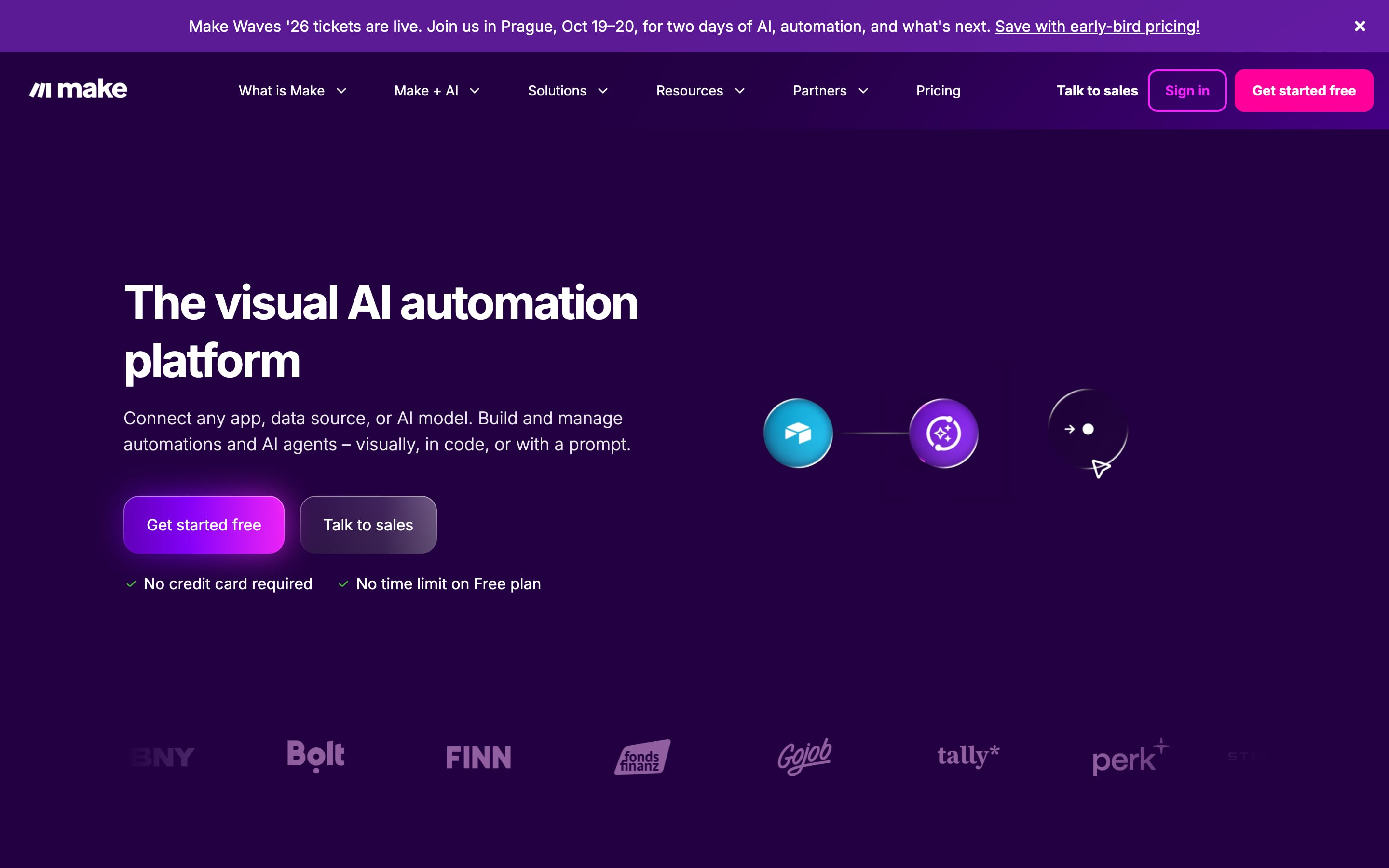
Make is a visual automation platform that GTM teams use to connect the tools in their stack without writing much code. Scenarios are built on a canvas: a trigger, then modules that read, create or update records in connected apps, with routers, filters and iterators for branching and looping. Make lists more than 3,000 prebuilt app connectors, plus HTTP and webhook modules for anything without one, and it has moved into agentic automation with Make AI Agents and a Make MCP Server that lets an AI model call scenarios as tools. The product started life as Integromat, a Czech company that Celonis acquired in October 2020 and later rebranded. It is now marketed as trusted by more than 400,000 organizations across 200+ countries, run by a team the company puts at 350 plus. Billing is consumption based rather than per seat: each action consumes credits, most actions costing one, and the pricing FAQ states that credits became the billing unit on August 27, replacing operations. That model keeps entry cheap, a free tier at 1,000 credits per month and a Core plan at 9 dollars, but a high volume scenario that loops over thousands of rows can burn a monthly allowance quickly, so cost modelling matters before you scale. Reviewers consistently flag a steeper learning curve than simpler automation tools, occasional bugs and slow support.
Key features
- Visual scenario builder with routers, filters and iterators
- 3,000+ prebuilt app connectors plus HTTP and webhook modules
- Make AI Agents for model-driven orchestration across apps
- Make MCP Server exposing scenarios as tools to AI models
- Templates library and shareable team templates
- Make API access from the Core plan
- Execution logs with full-text search on Pro and above
- Enterprise custom functions, overage protection and advanced security
Pros
- Visual canvas with routers, filters and iterators handles branching logic that simpler automation tools cannot express
- More than 3,000 prebuilt app connectors, plus HTTP and webhook modules for anything unlisted
- Consumption pricing means cost scales with usage, not with how many people touch the account
- AI Agents and an MCP Server bring model-driven orchestration into the same canvas
- Entry price is low: a free tier with 1,000 credits and a $9 Core plan
- Rated 4.8 from 408 reviews on GetApp, with the free plan and pricing flexibility cited as buying reasons
Cons
- Reviewers report a steeper learning curve than simpler automation tools
- Reviewers report occasional bugs and limited support responsiveness, with no live chat on lower tiers
- Consumption billing can produce unpredictable costs when scenarios loop over large datasets
- The free plan is heavily capped: 2 active scenarios, a 15 minute minimum interval and 5 minute executions
- Public review sentiment diverges sharply, with GetApp at 4.8 and Trustpilot at 2.8 out of 5
Last round
Acquired by Celonis in October 2020, reported at over $100M, and later rebranded from Integromat to Make (reported)
Cost at scale
Cost follows credit consumption, not seats. Core is $9 per month for 10,000 credits, which works out near $92 per year if the advertised 15 percent annual saving applies, while a scenario iterating over thousands of rows consumes the same allowance far faster than a low volume one.
Users claimed
400,000+ organizations across 200+ countries claimed
| Plan | Price | Limits | Includes |
|---|---|---|---|
| Free | $0 per month | 2 active scenarios, 15 minute minimum interval, 5 minute maximum execution time, 5MB file size, 7 day log retention | 1,000 credits per month, No-code builder with routers and filters, Access to 3,000+ apps |
| Core | $9 per month, 10,000 credits | 10,000 credits per month, extra credits billed on top | Unlimited active scenarios, Scheduling down to the minute, Make API access, Increased data transfer |
| Pro | $16 per month, 10,000 credits | 10,000 credits per month | Priority scenario execution, Custom variables, Full-text execution log search |
| Teams | $29 per month, 10,000 credits | 10,000 credits per month | Team management with roles, Create and share scenario templates |
| Enterprise | Custom quote | Custom credit allowance, quoted | Custom functions and enterprise app integrations, 24/7 support and a Value Engineering team, Overage protection and advanced security, 60 day execution log retention |
From their published pricing, August 2026. Core is $9 per month for 10,000 credits, Pro $16 and Teams $29, with annual billing advertised at 15 percent or more off. Check their pricing page.
What reviews praise
- Reviewers praise the depth of the automation logic compared with simpler trigger-action tools
- Users report the free plan and flexible pricing as a reason to start
- Reviewers rate ease of integration highly, with Google Sheets, Airtable and Google Drive among the top-rated connectors
- Support is rated around 4.5 out of 5 on GetApp despite complaints about response times
What reviews flag
- Users report a steeper learning curve than competing automation platforms
- Reviewers report occasional bugs and slow support responses, with no live chat option mentioned
- Users report that consumption-based billing makes costs hard to predict when workflows are not optimized
- Trustpilot reviewers rate the company well below its software-directory scores
Distilled from public reviews and community threads. Not Weezly's opinion, and not a rating.
API access
Make API from the Core plan, plus HTTP and webhook modules and a Make MCP Server
Automation platforms
Make is itself the automation layer, with 3,000+ native app connectors
Integrations
 HubSpot
 Salesforce
 Slackmonday.comNetSuiteCanvaPerplexity AIDeepSeekGoogle SheetsGoogle DriveAirtable
- HQ
- Part of Celonis. Make's privacy notice names Celonis Inc., One World Trade Center, New York, as data controller
- Founded
- Started as Integromat in the Czech Republic, acquired by Celonis in October 2020 and later rebranded to Make (reported)
- Employees
- 350+, their own figure

 n8nSource available workflow automation with AI agent nodes, cloud or self hostedfrom €20/moFree plan
 PhantomBusterCloud automation platform of prebuilt Phantoms for public web data and workflowsfrom $69/moFree plan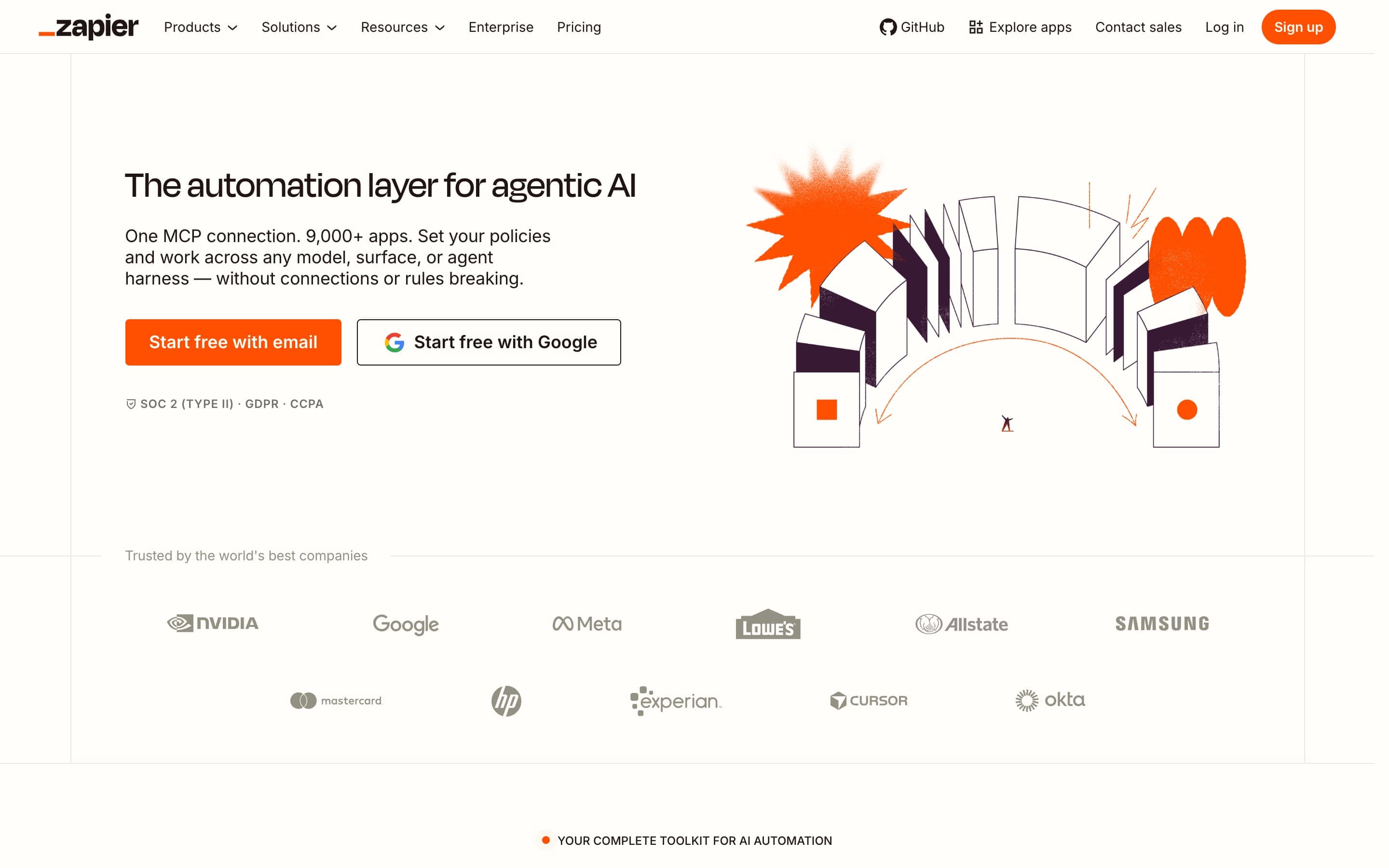
 ZapierNo code automation across 9,000 plus apps, billed by task volumefrom $19.99/moFree plan
There is a free plan with 1,000 credits per month. Paid plans in their published pricing in August 2026 are Core at $9 per month, Pro at $16 and Teams at $29, each with 10,000 credits, and annual billing is advertised at 15 percent or more off. Enterprise is quoted. Because billing follows credit consumption rather than seats, the real cost depends on how many actions your scenarios run, so check their pricing page and model your volume.
A credit is the billing unit. Each action a scenario performs consumes credits, most actions costing one, while some advanced features that use Make's AI provider consume more. Reading, searching, creating, updating and deleting records all count, as do data transformations and iterations. Their pricing FAQ states that credits became the billing unit on August 27, replacing the older operations model.
Yes. Integromat was a Czech company acquired by Celonis in October 2020, reported at over $100M, and it was later rebranded as Make. Existing coverage and older tutorials still refer to Integromat.
Yes. Make markets AI Agents that take action and orchestrate workflows across its 3,000+ connected apps, and a Make MCP Server that exposes scenarios to an AI model as callable tools. The platform positions itself as visual first, with code and prompt-based building as alternatives.
The free plan allows 1,000 credits per month with no time limit, but caps you at 2 active scenarios, a 15 minute minimum interval between runs, a 5 minute maximum execution time, 5MB files and 7 days of execution log history. Paid plans lift the scenario cap and allow scheduling down to the minute.
Directory information is compiled from vendors' own published materials and other public sources, dated at verification time, and provided as is for research purposes. All product names, logos and screenshots are the property of their respective owners and are used for identification only; Weezly is not affiliated with or endorsed by the listed vendors unless stated. Verify current terms with the vendor before purchasing. About the data