

 VS
VS
n8n vs Make
n8n and Make are both canvas built automation platforms priced by consumption rather than by seat, which makes them natural rivals inside a go to market engineering stack. Make, formerly Integromat and now part of Celonis, builds scenarios from a trigger and a chain of modules, with routers, filters and iterators for branching and looping, more than 3,000 prebuilt app connectors, HTTP and webhook modules for anything unlisted, Make AI Agents and a Make MCP Server. Billing runs on credits, most actions costing one, with a free tier at 1,000 credits per month and paid plans starting at $9. n8n is source available software distributed under a fair code licence and offered as managed cloud or as software you run yourself. It ships over 500 pre built nodes plus a generic HTTP request node, JavaScript and Python code steps anywhere in a flow, agent nodes with multiple model providers, retrieval patterns, human in the loop approvals and MCP support, and cloud plans priced per workflow execution with unlimited users on every plan. The axis of choice is where the automation runs and how much code you want to write, weighed against how many connectors you get out of the box.
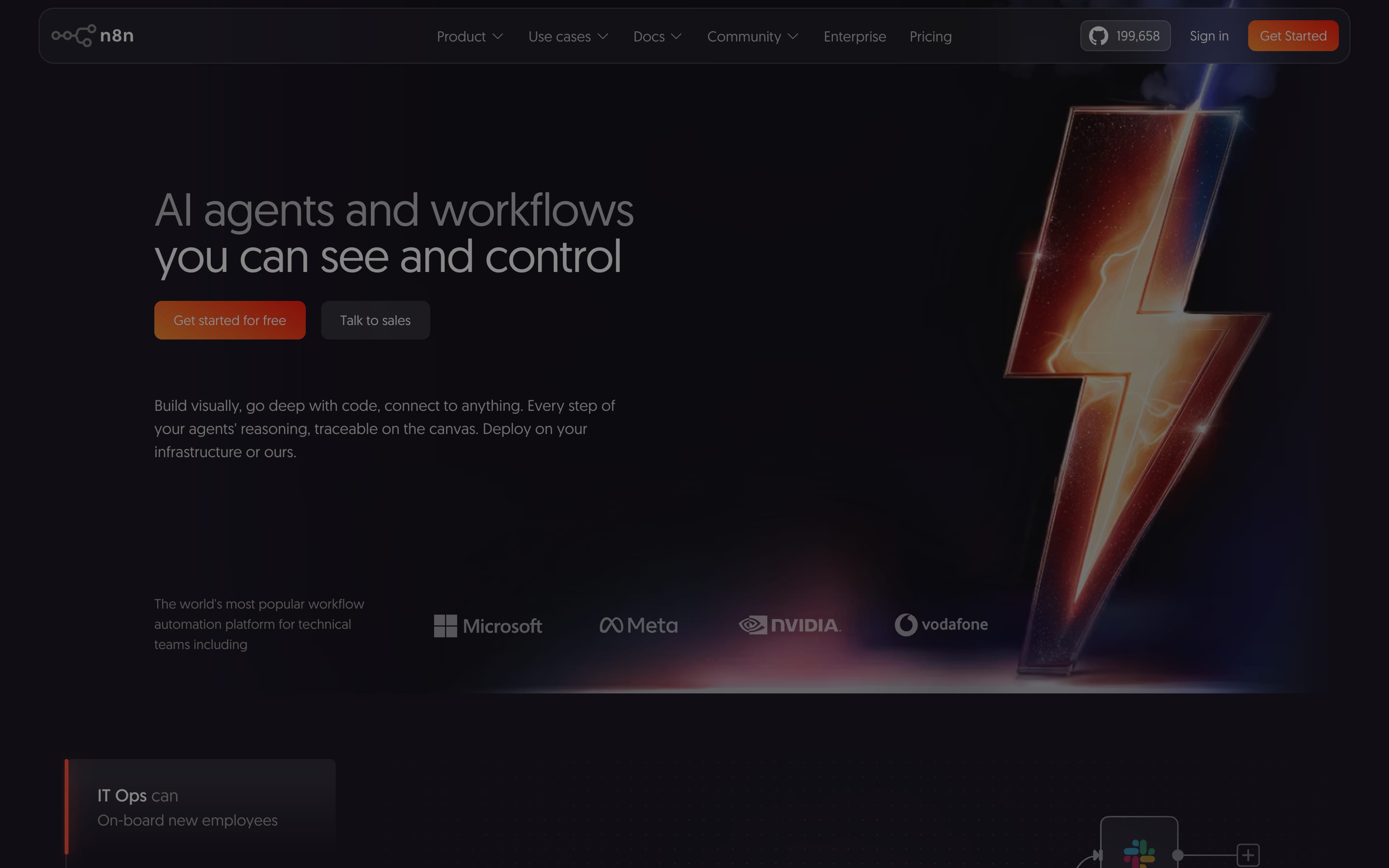
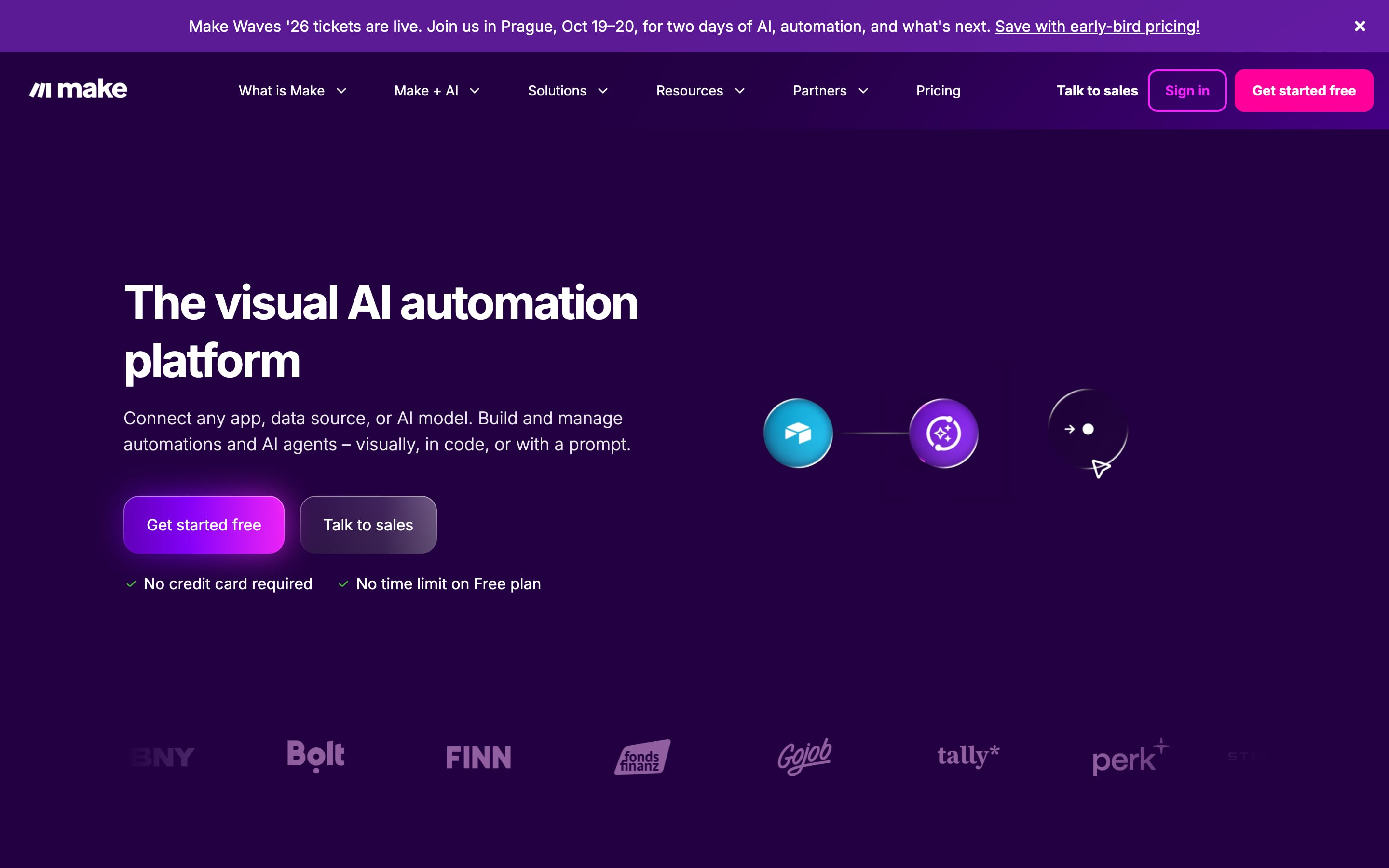
Both are canvas built and consumption priced, but n8n hands you code steps and the option to run the whole thing on your own servers, while Make hands you six times as many prebuilt connectors and a lower price at the entry line.
Pick n8n if
- Pick n8n if workflow data and credentials must stay on your own infrastructure, since the Community edition is free to self host and Business and Enterprise licence keys apply to self hosted instances.
- Pick n8n if the work needs real code, since JavaScript and Python steps run anywhere in a flow, while Make reserves custom functions for the Enterprise plan.
- Pick n8n if headcount is the growth axis, since every cloud plan includes unlimited users and bills by workflow execution.
- Pick n8n if you want to inspect or extend the platform itself, since the source is public on GitHub under the Sustainable Use License, which permits internal use and modification but restricts offering n8n itself as a service.
Pick Make if
- Pick Make if the apps you need are the deciding factor, since their published figure is more than 3,000 prebuilt connectors against over 500 pre built n8n nodes.
- Pick Make if the entry price matters most, since their published pricing in August 2026 lists Core at $9 per month for 10,000 credits alongside a free tier at 1,000 credits.
- Pick Make if you want branching and looping without code, through routers, filters and iterators on the canvas.
- Pick Make if you do not want to run anything yourself, since self hosting is not advertised and the platform is delivered as a managed service with AI Agents and an MCP Server included.
 n8n
n8n Maken8nMaken8n
You run, secure and upgrade it. Paid only features such as SSO, projects and workflow sharing are excluded, and the licence restricts offering n8n itself as a service
Full node library and code steps, Runs on your own infrastructure via Docker, Registered Community adds folders and debug features
1 shared project, 5 concurrent executions
2,500 workflow executions per month, Unlimited users, About 2,300 AI credits per month, Forum support
3 shared projects, 20 concurrent executions
10,000 workflow executions per month, Up to about 13,700 AI credits per month, Admin roles, workflow history and 7 day insights
6 shared projects
40,000 workflow executions per month, SSO, SAML and LDAP, Self hosted option and Git version control, 30 day insights
Quoted, contact sales
Custom execution volume, 200 plus concurrent executions, Unlimited shared projects and 365 day insights, External secret store integration, Dedicated support with an SLA and invoice billing
From their published pricing, August 2026. Cloud plans are quoted in euro and billed by workflow execution rather than by seat: Starter 20 euro per month billed annually for 2,500 executions, Pro 50 euro for 10,000, Business 667 euro for 40,000, Enterprise quoted. Monthly billing costs more than the annual rates shown. The self hosted Community edition is free. Check their pricing page.
Make2 active scenarios, 15 minute minimum interval, 5 minute maximum execution time, 5MB file size, 7 day log retention
1,000 credits per month, No-code builder with routers and filters, Access to 3,000+ apps
10,000 credits per month, extra credits billed on top
Unlimited active scenarios, Scheduling down to the minute, Make API access, Increased data transfer
10,000 credits per month
Priority scenario execution, Custom variables, Full-text execution log search
10,000 credits per month
Team management with roles, Create and share scenario templates
Custom credit allowance, quoted
Custom functions and enterprise app integrations, 24/7 support and a Value Engineering team, Overage protection and advanced security, 60 day execution log retention
From their published pricing, August 2026. Core is $9 per month for 10,000 credits, Pro $16 and Teams $29, with annual billing advertised at 15 percent or more off. Check their pricing page.
n8n pros
- Self hostable, so workflow data and credentials can stay inside your own infrastructure
- Priced per workflow execution with unlimited users on every cloud plan
- JavaScript and Python code steps anywhere in a flow, plus a generic HTTP node for any unlisted API
- AI agent nodes with multiple model providers, retrieval patterns, human in the loop approvals and MCP support
- Large public template library, over 10,000 templates claimed, and a community of more than 200,000 members
n8n cons
- Not OSI open source, the Sustainable Use License restricts offering n8n itself as a service
- The price step from Pro at 50 euro to Business at 667 euro per month is large for teams that outgrow 10,000 executions
- Around 500 pre built nodes, well below the connector counts of the largest no code platforms
- A reviewer reports the depth can overwhelm beginners and that documentation examples can be sparse
Make pros
- Visual canvas with routers, filters and iterators handles branching logic that simpler automation tools cannot express
- More than 3,000 prebuilt app connectors, plus HTTP and webhook modules for anything unlisted
- Consumption pricing means cost scales with usage, not with how many people touch the account
- AI Agents and an MCP Server bring model-driven orchestration into the same canvas
- Entry price is low: a free tier with 1,000 credits and a $9 Core plan
Make cons
- Reviewers report a steeper learning curve than simpler automation tools
- Reviewers report occasional bugs and limited support responsiveness, with no live chat on lower tiers
- Consumption billing can produce unpredictable costs when scenarios loop over large datasets
- The free plan is heavily capped: 2 active scenarios, a 15 minute minimum interval and 5 minute executions


The units are not comparable line for line, so model your own volume. Self hosting the n8n Community edition is free, and in their published pricing in August 2026 cloud Starter is 20 euro per month billed annually for 2,500 executions, Pro is 50 euro for 10,000 and Business is 667 euro for 40,000. In Make's published pricing in August 2026, Core is $9 per month for 10,000 credits, Pro is $16 and Teams is $29, with a free tier at 1,000 credits and annual billing advertised at 15 percent or more off. n8n counts one execution per workflow run regardless of how many nodes fire, while Make consumes a credit per action, so a twenty step scenario costs one n8n execution and roughly twenty Make credits. Check both pricing pages.
Yes. Both expose webhooks and HTTP modules, and n8n documents interoperating with Make and similar tools that way, so either can trigger the other. A practical split is keeping scenarios that depend on a Make only connector where they are, and moving code heavy or data sensitive pipelines into n8n, where they can run on your own infrastructure.
n8n offers self hosting from free Community through licensed Enterprise, code steps in JavaScript and Python anywhere in a flow, Git based version control and environments on Business and Enterprise, unlimited users on every cloud plan, and workflows that export as JSON. Make offers a larger prebuilt connector catalogue, routers, filters and iterators for visual branching, full text execution log search on Pro and above, and team roles from the Teams plan, with custom functions on Enterprise only and self hosting not advertised. Both ship AI agents and MCP support.
Reviewers report a steeper curve for both than for simple trigger and action tools. A SourceForge reviewer reports that n8n's depth can overwhelm beginners, that documentation examples can be sparse and that very large workflows refresh slowly. Make reviewers report a steeper learning curve than competing automation platforms, occasional bugs and slow support responses, and public sentiment for Make diverges sharply, with 4.8 from 408 reviews on GetApp against 2.8 out of 5 on Trustpilot.
Directory information is compiled from vendors' own published materials and other public sources, dated at verification time, and provided as is for research purposes. All product names, logos and screenshots are the property of their respective owners and are used for identification only; Weezly is not affiliated with or endorsed by the listed vendors unless stated. Verify current terms with the vendor before purchasing. About the data