 VS
VS
Attio vs HubSpot
Attio and HubSpot both want to be the system of record, and they disagree about where a CRM should start. Attio is built on a configurable data model rather than a fixed lead, contact and opportunity schema: a workspace is assembled from objects, attributes and lists, records populate themselves from connected email and calendar accounts, and paid tiers add sequences, call intelligence, funnel reporting, permission controls and AI agents that research accounts, enrich and score leads and route them to reps. There is a real developer surface, with a REST API and webhooks on every tier including Free, an app SDK, an MCP server and direct connections into Claude, ChatGPT and Notion. HubSpot is a customer platform whose Sales Hub sits on a CRM that is free for up to two users, and its pull is consolidation: deal pipelines, sequences, calling, scheduling, dashboards, forecasting and conversation intelligence share records with marketing and service data, inside a very large app marketplace. The axis of choice is whether you want to shape the schema yourself or inherit one that works already, and whether the ecosystem or the data model is what you will be fighting a year from now.
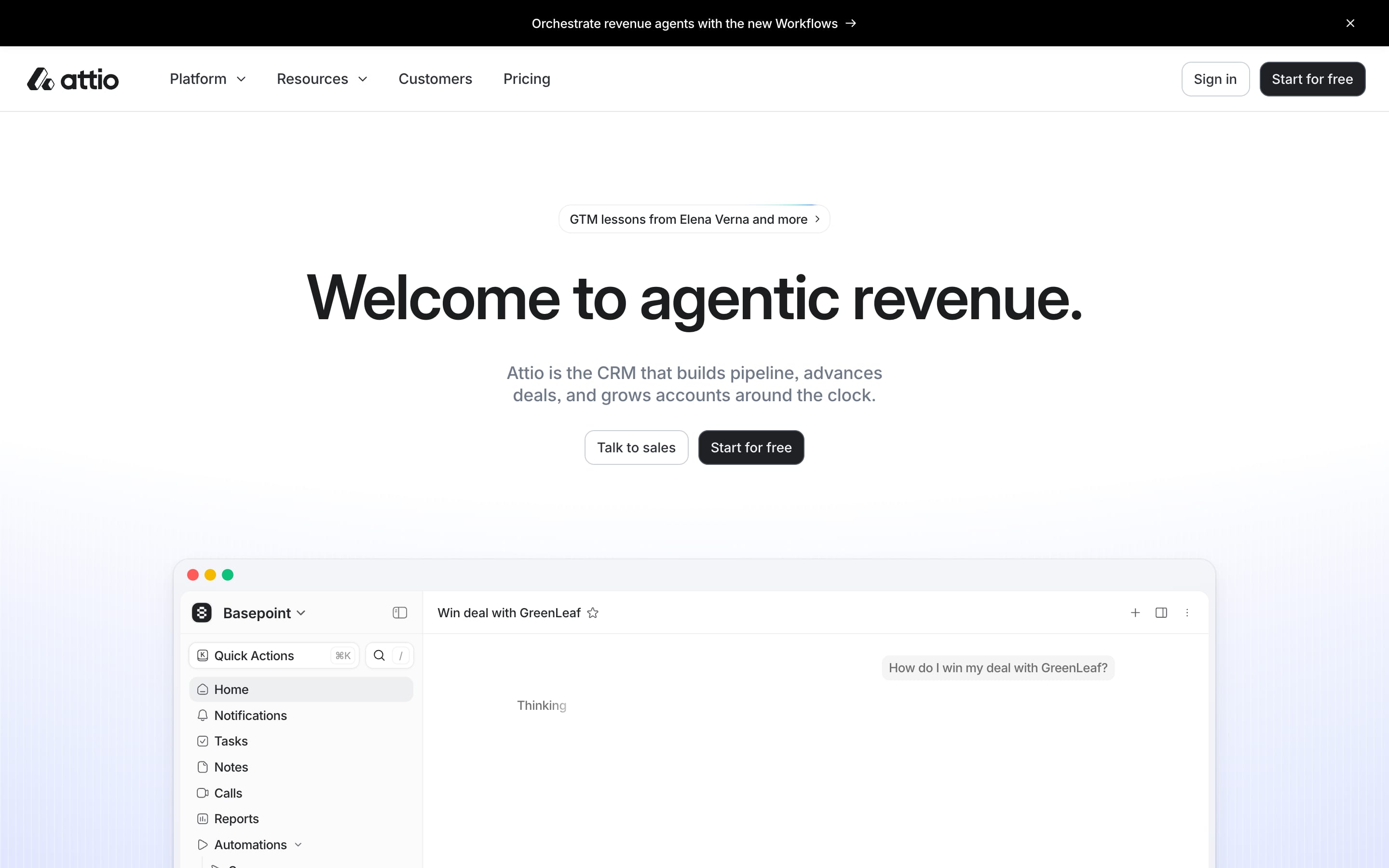
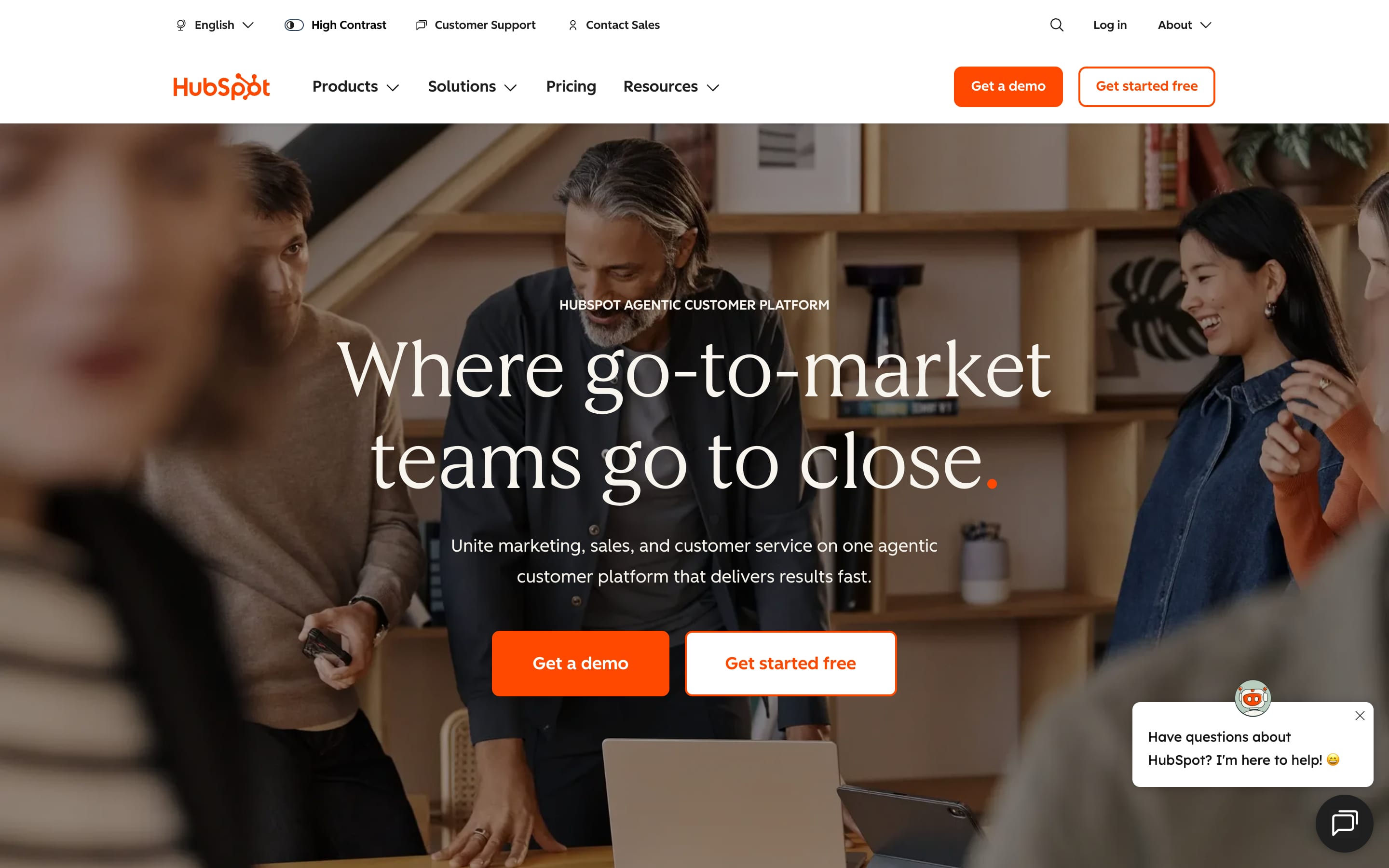
Attio is the choice when the data model matters more than the pipeline template, and HubSpot is the choice when the breadth of one platform and its ecosystem matters more than the shape of the schema.
Pick Attio if
- Pick Attio if the business does not fit lead, contact and opportunity, since custom objects and attributes let you model deals, investors, partners or usage based accounts inside the product.
- Pick Attio if the developer surface matters, since the REST API and webhooks are on every tier including Free, alongside an app SDK, an MCP server and direct connections into Claude, ChatGPT and Notion.
- Pick Attio if you want a real evaluation rather than a countdown, since the free tier is permanent for up to three seats with 50,000 records, automatic enrichment and API access.
- Pick Attio if you want record history to build itself, since email and calendar sync logs activity onto records automatically, which the company markets as Universal Context.
Pick HubSpot if
- Pick HubSpot if sales, marketing and service should sit on one record system, which is the main reason teams buy the platform rather than a point CRM.
- Pick HubSpot if reps need to call from the CRM, since calling is built in with 500 minutes on Starter and a power dialer on higher tiers, while Attio does not advertise a native dialer.
- Pick HubSpot if you need sequences early, since they start on Sales Hub Starter, whereas Attio puts sequences and Call Intelligence on the Pro tier.
- Pick HubSpot if third party validation and a large partner ecosystem matter to procurement, since Software Advice reviewers rate Sales Hub 4.5 out of 5 across 503 reviews while Attio's public review coverage is thin, at roughly 5 Trustpilot reviews and no Capterra CRM listing found in August 2026.
AttioHubSpotAttioHubSpotAttioUp to 3 seats, 3 objects, 50,000 records, 3 reports, 200 emails per month, no permissions
Real-time contact syncing, Automatic data enrichment, API and webhook access, 100 seat credits per user per month
$44 billed monthly. Up to 10 seats, 5 objects, 250,000 records, 15 reports, 1,000 emails per month
Private lists, Enhanced email sending, Basic access permissions, 500 seat credits per user per month
$99 billed monthly. Unlimited seats, 12 objects, 1,000,000 records, 100 reports
Call Intelligence and sequences, Advanced permission controls, Funnel and insight reporting, 1,000 seat credits per user per month
Custom record and report limits, quoted
Unlimited objects and teams, Single sign-on and SCIM, Payment by invoice and CSV export limits, Migration service
From their published pricing, August 2026, per user per month billed annually. Billed monthly Plus is $44 and Pro is $99. Workspace credit blocks are extra. Check their pricing page.
HubSpotUp to 2 users and 1,000 contacts, HubSpot branding on assets
Contact management and deal pipelines, Email tracking, meeting scheduler and live chat, Reporting dashboard and Breeze assistant, iOS and Android apps
3 email templates and 3 snippets per account, 1 personal meetings link, 5 lead scores. Advertised at $7 per seat per month on annual commitment as a limited time new customer offer.
Sequences with up to 500 sequence emails per user per day, 500 calling minutes, 2 deal pipelines and 10 dashboards, 500 HubSpot Credits
One time onboarding fee of $1,500, sold as Sales Seats
Up to 300 workflows and 15 deal pipelines, Forecasting, advanced reporting and conversation intelligence, 3,000 HubSpot Credits
One time onboarding fee of $3,500, sold as Sales Seats
Up to 1,000 workflows and 100 deal pipelines, Advanced permissions, custom objects and admin controls, 5,000 HubSpot Credits
From their published pricing, August 2026. Sales Hub Starter shows $20 per seat per month on monthly commitment and $7 per seat per month on annual commitment, presented as a limited time offer for new customers, while third party listings show a $15 per seat annual rate. Professional is $100 per seat monthly or $90 annual plus a one time $1,500 onboarding fee, Enterprise starts at $150 per seat plus a $3,500 onboarding fee. Check their pricing page.
Attio pros
- Custom objects and attributes let teams model a business that does not fit lead, contact and opportunity
- Email and calendar sync builds record history automatically, marketed as Universal Context
- Genuine developer surface: REST API and webhooks on every tier including Free, plus an app SDK and MCP server
- Permanently free tier for up to 3 seats, useful for a real evaluation rather than a countdown trial
- Direct connections into Claude, ChatGPT and Notion, alongside agent Workflows for prospecting and routing
Attio cons
- Sequences and Call Intelligence only start on Pro at $79 per user per month billed annually
- Enrichment and AI usage is metered by seat and workspace credits, with extra blocks from about $70 per month
- Free and Plus cap objects, records, reports and monthly email volume
- A native dialer is not advertised, so outbound calling depends on external tools
HubSpot pros
- A genuinely usable free CRM tier, so the pipeline can exist before any budget does
- Sequences, calling, meeting links, tasks and deal stages live on the same records as marketing and service data
- Reporting and forecasting depth that few point tools match, with 10 dashboards even on Starter
- Very large app marketplace plus documented REST APIs and webhooks, so it is easy to make it the system of record
- Published security posture including a SOC 2 Type 2 report, a public SOC 3 report and an EU data centre option
HubSpot cons
- Reviewers consistently report that cost grows quickly with extra seats, hubs and premium services
- One time onboarding fees of $1,500 on Professional and $3,500 on Enterprise are mandatory in their published pricing
- Starter limits are tight: 3 email templates per account, 1 personal meetings link, 2 deal pipelines
- AI and enrichment run on metered HubSpot Credits, so usage costs sit on top of seat costs
Both publish prices and both have a free tier, so the comparison depends on the tier you land on. In Attio's published pricing in August 2026, Free covers up to three seats, Plus is $35 per user per month billed annually and Pro is $79, with Enterprise quoted, and billed monthly those are $44 and $99. In HubSpot's published pricing in August 2026, the CRM is free for up to two users and 1,000 contacts, Sales Hub Starter is $20 per seat per month on monthly commitment and is advertised at $7 per seat per month on annual commitment as a limited time offer for new customers, with third party listings showing $15 annual. Above that, HubSpot Professional is $100 per seat monthly or $90 annual plus a one time $1,500 onboarding fee, and Enterprise starts at $150 per seat plus $3,500. HubSpot Starter undercuts Attio Plus, while Attio Pro at $79 sits below HubSpot Professional and carries no onboarding fee. Check both pricing pages.
Yes. Attio grants seat credits per user per month, from 100 on Free up to 2,500 on Enterprise, plus a workspace credit pool, and sells extra workspace credits in blocks of 5,000 to 50,000 per month from about $70 per month billed annually. HubSpot meters Breeze AI features and data enrichment with HubSpot Credits at $0.01 per credit beyond the allowance included in each tier, which is 500 on Starter, 3,000 on Professional and 5,000 on Enterprise. On both platforms heavy automation adds cost above the seat price.
Two CRMs as the system of record is uncommon, and the more usual overlap is a migration. Attio ships importers from Salesforce, HubSpot, Pipedrive, Zoho, Excel and CSV, and offers a migration service on Enterprise. If they do run side by side during a transition, both expose REST APIs and webhooks and both connect to Zapier, and HubSpot also lists Make, n8n and Workato alongside its App Marketplace.
Attio gives you custom objects and attributes, capped at 3 objects on Free, 5 on Plus and 12 on Pro with unlimited on Enterprise, plus agent Workflows, an AI research agent and funnel reporting. Sequences and Call Intelligence begin on Pro, a native dialer is not advertised, and email sending is capped at 200 per month on Free and 1,000 on Plus before going unlimited on Pro. HubSpot gives you built in calling, sequences from Starter with a 500 email per user per day cap, conversation intelligence on Professional and Enterprise, forecasting, and marketing and service hubs on the same records, with tight Starter limits of 3 email templates per account, 1 personal meetings link and 2 deal pipelines. Neither advertises automated LinkedIn sending.
Directory information is compiled from vendors' own published materials and other public sources, dated at verification time, and provided as is for research purposes. All product names, logos and screenshots are the property of their respective owners and are used for identification only; Weezly is not affiliated with or endorsed by the listed vendors unless stated. Verify current terms with the vendor before purchasing. About the data
One of these tools is ours.
Weezly is in this directory too: LinkedIn outreach with AI clone videos, a 300M+ leads database and booking, from $59 per month. See if it earns a spot in your stack.